Standard Operating Procedures for Veterinary Clinics (SOPs): The Complete, Updated Guide
Standard operating procedures for veterinary clinics are the “how we do it here” playbook that turns good medicine into consistent medicine. In a busy hospital, even highly skilled teams can drift into shortcuts: a missed anesthesia checklist, an unlabeled syringe, an incomplete controlled-drug log, or a rushed discharge that leaves a client confused.
Standard operating procedures for veterinary clinics solve that by creating repeatable workflows that protect patients, staff, clients, and the business.
From an operator’s perspective, veterinary clinic SOPs are also your fastest path to scalability. When you add a new doctor, a relief tech, or a second location, you can’t rely on tribal knowledge. Standard operating procedures for veterinary clinics make performance teachable, measurable, and auditable—so outcomes don’t depend on who happened to be working that day.
From a compliance perspective, SOPs are where regulations and professional guidance become daily habits. For example, controlled substances require disciplined inventory, recordkeeping, and theft/loss reporting under federal rules in 21 CFR Part 1304, and DEA guidance on reporting theft/loss (Form 106).
Likewise, workplace safety expectations (hazard communication, sharps practices, PPE, injury prevention) are reinforced by OSHA frameworks and public health guidance for veterinary teams.
If your goal is to build a clinic that’s clinically excellent, client-trusted, and operationally stable, start with standard operating procedures for veterinary clinics—and treat them as a living system, not a binder on a shelf.
Why Standard Operating Procedures for Veterinary Clinics Matter More Than Ever
Standard operating procedures for veterinary clinics used to be “nice to have.” Today, they’re essential because clinics face tighter labor markets, higher caseload complexity, more advanced therapeutics, and elevated client expectations.
When appointment volume rises, the risk profile rises too: anesthesia events, bite incidents, sharp injuries, medication errors, missed callbacks, and breakdowns in the veterinary-client-patient relationship (VCPR).
SOPs reduce those risks by standardizing critical control points. In surgery, a consistent pre-op process ensures consent, fasting confirmation, catheter placement, analgesia planning, and monitoring readiness.
AAHA’s anesthesia and monitoring guidance emphasizes a structured approach to patient assessment, monitoring, and pain management—elements that translate directly into SOP checklists and training.
Operationally, standard operating procedures for veterinary clinics protect your schedule and revenue. A clean workflow for diagnostics reduces rechecks caused by poor sample handling. A consistent discharge process improves adherence, which reduces complications and after-hours calls.
A disciplined inventory SOP reduces expired drugs and shrink. Even client experience improves: when your team uses the same language for estimates, follow-ups, and home care, trust goes up and friction goes down.
A practical benchmark is accreditation-style thinking. AAHA accreditation evaluates clinics across numerous categories—recordkeeping, anesthesia, pain management, client communication, and team training—exactly the domains where standard operating procedures for veterinary clinics make the biggest difference.
Governance: Regulations, Standards, and Who “Owns” Your SOP System

Standard operating procedures for veterinary clinics work only when ownership is clear. In high-performing practices, SOP governance is shared:
- The medical director owns clinical standards (triage, diagnostics, anesthesia, surgery, prescribing, euthanasia).
- The practice manager owns administrative and compliance systems (HR, purchasing, client communication standards, incident reporting).
- Lead technician / technician supervisor owns technical workflows (sample handling, imaging prep, instrument care, inpatient flow).
- Controlled substance custodian (often a lead or manager) owns controlled-drug security, logs, audits, and discrepancy resolution.
Governance must also reflect the real regulatory landscape. Controlled substance recordkeeping requirements are not optional; they are defined in federal regulations (21 CFR Part 1304), and additional DEA expectations apply for reporting theft or significant loss (DEA Form 106 submitted electronically per updated rules).
Standard operating procedures for veterinary clinics should spell out: ordering, receiving, storage, dispensing/administering documentation, wasting, inventory counts, and end-of-bottle reconciliation.
On the safety side, your SOPs should align with workplace hazard controls: sharps handling, exposure prevention, PPE selection, hazard communication, and training. CDC/NIOSH resources summarize how OSHA-style standards apply to veterinary teams, including sharps and zoonotic hazards.
Finally, governance should include a review cadence. A common rule is: review high-risk SOPs quarterly (anesthesia, controlled substances, radiology safety, hazardous drugs), and review the rest at least annually, or sooner after any incident, near-miss, or vendor change.
Building Standard Operating Procedures for Veterinary Clinics That People Actually Follow
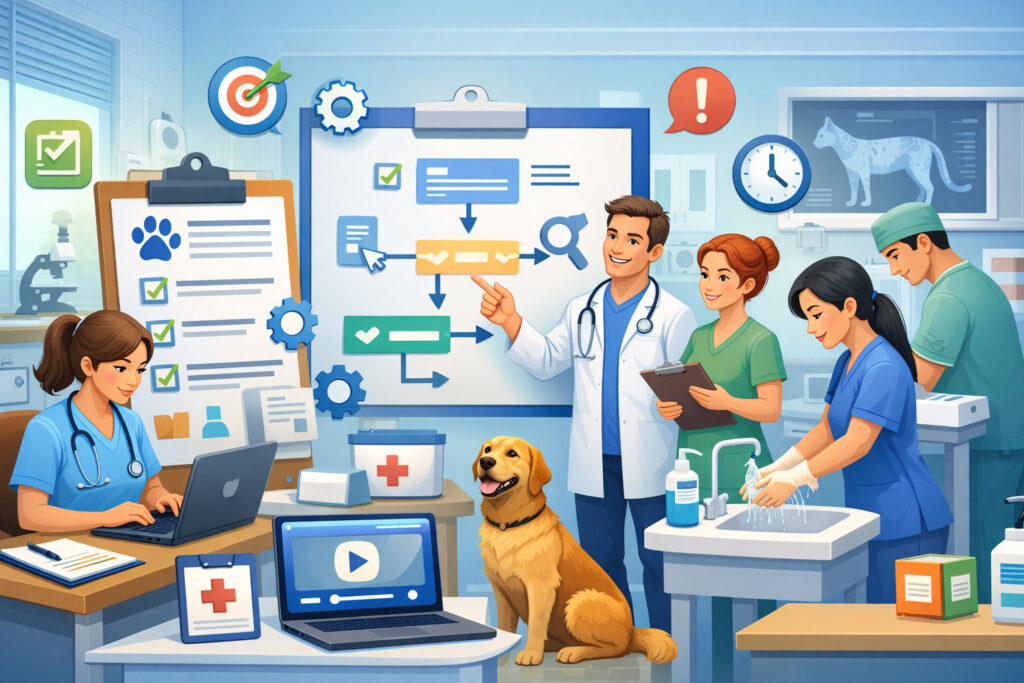
Standard operating procedures for veterinary clinics fail when they’re written like textbooks. Teams follow SOPs when they are fast, visual, and frictionless. Build yours with these design principles:
- One task = one SOP: Avoid mega-documents. “Blood draw and sample labeling” should not be buried inside “Lab operations.”
- Use the clinic’s real workflow: Write SOPs after shadowing your actual process, not the process you wish you had.
- Add decision points: Great SOPs say what changes when the patient is aggressive, the vein blows, or the lab machine flags an error.
- Define roles: If the CSR, tech, and doctor all think someone else is calling the client, no one calls.
- Embed quality checks: Example: “Before submitting samples: verify patient ID on tube + requisition + EMR.”
- Make it teachable: Include time targets (e.g., “triage within 3 minutes”), equipment lists, and common errors.
Real-world example: a two-doctor clinic was losing 4–6 appointments weekly to “long rooms.” They implemented standard operating procedures for veterinary clinics around rooming: CSR pre-check, tech intake script, standardized vitals, and an “exam ready” visual cue. The result wasn’t just speed—it was fewer missed history details and fewer callback errors.
The final step is version control. Every SOP needs: title, scope, owner, effective date, revision date, and training sign-off method. Without that, you can’t prove consistency—especially after an incident.
Front Desk, Phone Triage, and Client Communication SOPs
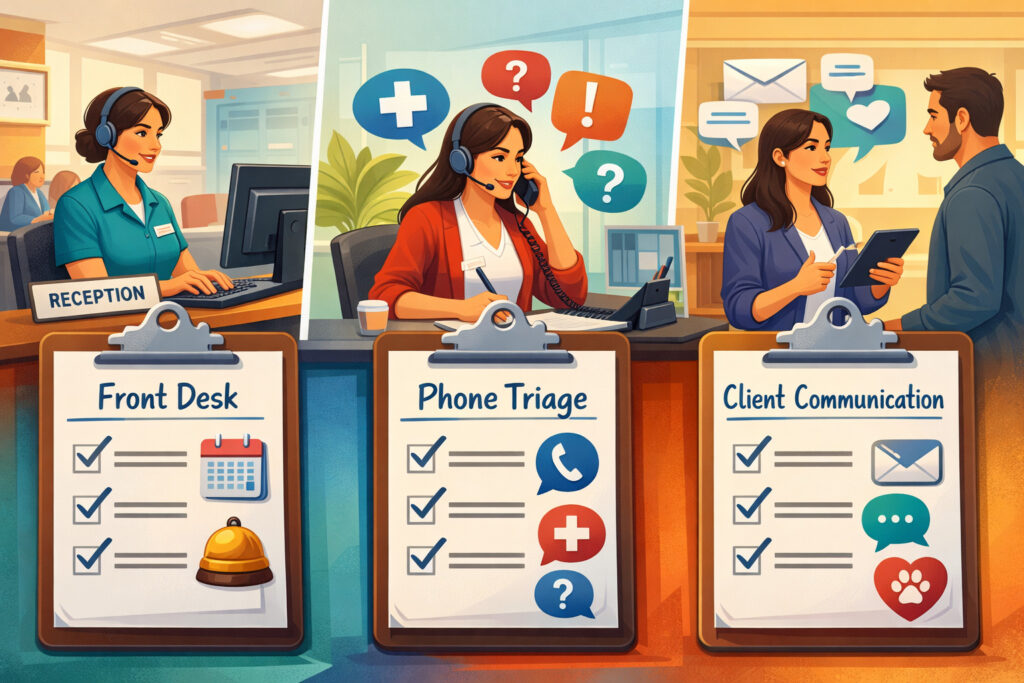
Standard operating procedures for veterinary clinics should start at the front door because most failures begin with communication. Your CSRs are managing medical risk in disguise: they decide how fast a patient is seen, how clearly instructions are delivered, and whether a complaint escalates or resolves.
A strong phone SOP includes:
- Red-flag triage prompts (respiratory distress, active bleeding, toxin exposure, collapse, dystocia, GDV signs).
- Scripted next steps (“Go to the nearest emergency hospital now” plus what to bring, what not to do, and ETA expectations).
- VCPR and scheduling boundaries (when advice becomes medicine).
- Estimate framing and authorization language (reduces disputes later).
Client communication SOPs should standardize:
- How you present treatment plans and document consent.
- How you handle refusals (“declined diagnostics” notes protect the clinic medically and legally).
- How you deliver bad news and transitions to palliative care.
- How you confirm discharge comprehension (teach-back method: “Tell me how you’ll give this medication at home.”)
This is also where standard operating procedures for veterinary clinics improve online reputation. Most negative reviews are not “the medicine was wrong,” but “no one explained what was happening.” A simple SOP—callback within 2 business hours for hospitalized updates, and same-day lab results communication—can dramatically reduce complaints.
Exam Room Workflow and Medical Documentation SOPs
Standard operating procedures for veterinary clinics should make the exam room predictable. A clean exam workflow reduces missed diagnoses and prevents “case drift,” where nobody is fully sure what the plan is.
A reliable exam SOP typically includes:
- Pre-rooming review (previous notes, chronic conditions, vaccine status, alerts like bite risk).
- Structured history (chief complaint, onset, appetite, GI, urination/defecation, meds, travel/exposure, parasite control).
- Vitals + pain scoring and body weight confirmation (weight drives dosing accuracy).
- SOAP-style documentation (Subjective, Objective, Assessment, Plan) or a consistent equivalent.
- Problem list and differential diagnosis discipline (keeps chronic cases from becoming guesswork).
Medical record SOPs should reflect that veterinary record rules vary by jurisdiction, and clinics should align with professional expectations and local requirements. Many risk-management resources stress knowing your practice act, retention rules, and VCPR expectations.
Standard operating procedures for veterinary clinics should clearly define what “complete” means: exam findings, diagnostics offered, client decisions, meds with dose and route, home care instructions, and follow-up plan.
Real-world example: clinics often lose time because lab results aren’t attached correctly or the plan isn’t updated. A documentation SOP that requires “results reviewed + client notified + plan updated” as a single workflow closes the loop and reduces rework.
Infection Control, Biosecurity, and Sharps Safety SOPs
Standard operating procedures for veterinary clinics must assume every day includes exposure risk: zoonotic disease, fecal pathogens, ringworm, respiratory viruses, and bite/scratch incidents. Infection control is not one SOP—it’s a system: isolation flow, cleaning chemistry, PPE rules, and training.
A practical infection control SOP framework includes:
- Standard precautions for all patients (hand hygiene, gloves when appropriate, eye protection for splash risk).
- Transmission-based precautions (contact, droplet, aerosol) with an isolation room workflow.
- Cleaning and disinfection schedules with labeled products, correct dilution, and contact times.
- Laundry handling, spill response, and biohazard segregation.
- Post-exposure response (needlestick, bite, mucous membrane exposure): immediate steps and reporting.
Sharps deserve their own SOP because they are a high-frequency injury source. OSHA-related guidance highlights the importance of proper sharps containers and safe placement in clinical areas.
Standard operating procedures for veterinary clinics should include: no recapping (unless a one-handed technique is unavoidable), immediate disposal, container fill limits, and what to do after a stick.
Real-world example: one hospital reduced sharps injuries by placing sharps containers at every treatment station and adding a “needle off immediately” rule with monthly audit feedback. Standard operating procedures for veterinary clinics work best when the environment supports the behavior.
Hazardous Drugs SOPs (Chemotherapy, Hormones, and High-Risk Agents)
Standard operating procedures for veterinary clinics increasingly must address hazardous drugs. Many general practices now handle chemotherapy agents, immunosuppressants, and hormone therapies.
The NIOSH List of Hazardous Drugs (2024) reflects ongoing updates in what qualifies as hazardous and reinforces why clinics need formal handling controls.
Your hazardous drug SOP should cover the full lifecycle:
- Receiving and unpacking (who opens shipments, where it happens, and what PPE is required).
- Storage (segregation, labeling, and spill supplies nearby).
- Preparation/compounding (what is done in-house vs outsourced; how exposure risk is minimized).
- Administration (closed-system transfer devices when appropriate, PPE, priming lines, patient restraint planning).
- Waste and excreta handling (urine/feces precautions for a defined period after dosing).
- Spill response (spill kit location, containment steps, disposal, incident reporting).
- Training and competency (initial and annual).
Many clinics use USP <800> as a safety benchmark because it provides a structured approach to minimizing exposure to hazardous drugs for personnel, patients, and the environment, with implementation resources updated in late 2023.
Even if not formally required in every veterinary setting, aligning standard operating procedures for veterinary clinics with USP-style controls is a strong E-E-A-T signal: it demonstrates you’re using recognized safety standards and modern best practices.
Diagnostics: Lab Samples, Imaging, and Chain-of-Custody SOPs
Standard operating procedures for veterinary clinics should treat diagnostics like a production line: errors are usually process errors, not people errors. The most common failures are mislabeled tubes, improper storage, delayed centrifugation, hemolysis from technique, and incomplete requisitions.
A strong lab SOP includes:
- Patient identification rules (two identifiers).
- Tube type selection and fill volumes.
- Labeling at the patient’s side (not “later at the counter”).
- Storage temps and transport timing.
- QA steps for in-house analyzers (controls, maintenance logs, and error codes).
Imaging SOPs should cover:
- Radiation safety roles, signage, and restraint policy (chemical restraint vs manual restraint).
- Equipment warm-up, calibration, and image labeling rules.
- How images are stored and shared (client copies, referral transfers).
- Who can operate equipment based on training.
If your clinic performs legal or controlled procedures (bite quarantine documentation, cruelty cases, certain toxicology situations), chain-of-custody SOPs matter. They define how samples are collected, sealed, documented, stored, and transferred—protecting the integrity of results and the clinic’s credibility.
Real-world example: many clinics repeat radiographs due to positioning variation. A positioning SOP with “standard views” checklists reduces retakes, improves diagnostic quality, and saves staff time.
Surgery and Anesthesia SOPs That Reduce Preventable Events
Standard operating procedures for veterinary clinics are most critical in anesthesia because small omissions compound quickly. Your anesthesia SOP should be built around three pillars: pre-anesthetic assessment, standard monitoring, and pain management continuity—all strongly reinforced in AAHA anesthesia and monitoring guidance.
Key anesthesia SOP components:
- Pre-op evaluation (history, physical, ASA status, indicated labs, risk discussion).
- Equipment checks (oxygen source, leak test, scavenging, ET tubes, emergency drugs, warming tools).
- Dose calculation protocol (weight confirmation, double-checks for high-risk drugs).
- Monitoring standards (minimum parameters and frequency; who records and who responds).
- Thermoregulation and fluids (plans based on procedure and patient factors).
- Recovery monitoring (extubation criteria, pain reassessment, dysphoria management).
Surgical SOPs should include:
- Sterile pack preparation and instrument counts.
- Skin prep and surgeon scrub standards.
- Antibiotic timing rules when indicated.
- Complication pathway (hemorrhage protocol, arrest protocol, rapid response roles).
Real-world example: a clinic reduced post-op calls by standardizing discharge meds and “what to watch” guidance for each procedure type. Standard operating procedures for veterinary clinics shine here because they reduce variation without reducing clinical judgment.
Controlled Substances SOPs: Security, Logs, Wasting, and Audits
Standard operating procedures for veterinary clinics must be rigorous with controlled substances. The fastest way to lose trust (and invite serious consequences) is sloppy security, missing counts, or unclear documentation.
Federal recordkeeping frameworks in 21 CFR Part 1304 define baseline expectations for registrants who handle controlled substances. If theft or significant loss occurs, DEA Form 106 reporting is required through DEA’s theft/loss reporting process, and regulations have been updated to require electronic submission and clarify timing.
Your controlled substance SOP should specify:
- Physical security (locked storage, limited access, key control policy, camera placement where appropriate).
- Ordering and receiving (who signs, where inventory is stored, how invoices are retained).
- Per-dose documentation (patient, amount, date, prescribing DVM, reason).
- Wasting protocol (witness rules, documentation fields, disposal method).
- Inventory cadence (daily counts for high-use meds; weekly/monthly full audits).
- Discrepancy workflow (immediate recount, log review, interview steps, escalation).
- End-of-bottle reconciliation (required close-out behavior, not optional).
Real-world example: a clinic found “micro-loss” from inconsistent partial-dose documentation. After implementing standard operating procedures for veterinary clinics that required “drawn vs given vs wasted” tracking, discrepancies dropped sharply and staff anxiety improved because expectations were clear.
Emergency Preparedness and Critical Event SOPs
Standard operating procedures for veterinary clinics should assume emergencies will happen on the worst day: full schedule, short-staffed, and an unstable patient arrives. Your goal is not perfection—it’s a reliable response that buys time and reduces chaos.
Core emergency SOPs include:
- Triage and stabilization (oxygen first, IV access pathway, shock dose guidance references, vitals frequency).
- Crash cart standardization (contents list, expiration checks, location rules).
- CPR roles (compressor, airway, drugs, timer/recorder, runner).
- Transfer/referral workflow (who calls, what records go, how consent is documented).
- Client communication in crisis (clear options, costs, prognosis framing).
Critical event SOPs are equally important:
- Anesthesia arrest protocol aligned with your monitoring and emergency drugs.
- Aggressive animal incident (staff safety, separation, documentation).
- Needlestick injury protocol (immediate wash, reporting, medical evaluation).
- Power outage / oxygen failure (backup oxygen, patient relocation, temperature control).
A mature clinic tracks “near misses” the way aviation does. Every time something almost goes wrong, you update standard operating procedures for veterinary clinics and retrain quickly. This is how SOPs become a safety culture, not paperwork.
Humane Euthanasia, Aftercare, and Staff Support SOPs
Standard operating procedures for veterinary clinics must treat euthanasia as both a medical procedure and a human experience. Clinical consistency prevents patient distress; communication consistency prevents client trauma and reduces complaints.
Euthanasia SOPs should align with professional guidance on method selection, minimizing pain and anxiety, and ensuring a humane process. AVMA’s euthanasia guidance is a key reference point for appropriate methods and decision-making. Your SOP should include:
- Pre-appointment counseling (what to expect, time, aftercare options).
- Consent and identity verification.
- Sedation/analgesia pathway (to reduce fear and distress).
- IV catheter placement standards and backup routes.
- Confirmation of death and documentation steps.
- Aftercare chain (cremation paperwork, tags, storage, transfer timing).
- Special cases (infectious disease, large patients, owner-requested presence in prep areas).
Equally important: staff support SOPs. Compassion fatigue is real in veterinary medicine, and euthanasia volume can be a contributor. Build a simple debrief workflow: a two-minute “reset” after hard cases, rotation of euthanasia duties when possible, and a policy that empowers staff to step away briefly.
Real-world example: clinics that standardize “quiet room” preparation and a consistent script (“I will explain each step before I do it”) often see higher client trust and fewer emotional escalations.
Quality Assurance, Training, and Continuous Improvement SOPs
Standard operating procedures for veterinary clinics become powerful when you measure them. Quality assurance (QA) doesn’t have to be corporate—small clinics can do it with lightweight systems:
- Daily huddles (schedule risks, surgical cases, hospitalized patients).
- Weekly metrics (lab turnaround times, callback completion, anesthetic incidents, controlled drug discrepancies).
- Monthly chart audits (documentation completeness, consent forms, follow-up plans).
- Quarterly skills validation (catheter placement, radiology positioning, anesthesia monitoring, CPR drills).
Training SOPs should include onboarding tracks by role:
- CSR: phone triage scripts, estimates, de-escalation.
- Tech: sample handling, anesthesia monitoring, controlled substance documentation.
- DVM: medical record standards, prescribing policies, referral pathways.
- Kennel/assistant: cleaning SOPs, isolation flow, bite prevention.
Tie SOPs to competency sign-offs: “watched,” “performed with supervision,” “performed independently.” This reduces risk and boosts confidence for new hires.
One of the most “business-real” payoffs: standard operating procedures for veterinary clinics reduce turnover. People leave chaotic workplaces. Clear processes create psychological safety—team members know what “good” looks like and how to get help when a case goes sideways.
Future Predictions: Where Veterinary Clinic SOPs Are Headed Next
Standard operating procedures for veterinary clinics are evolving in three big directions: automation, risk intelligence, and higher safety standards.
- Automation and smart checklists: Clinics are moving SOPs out of binders and into practice management systems: automated reminders for anesthesia monitoring entries, discharge packet generation, inventory reorder triggers, and follow-up texting workflows. Expect SOP compliance to become more “built-in” and less dependent on memory.
- Greater focus on hazardous drug controls: As advanced therapies become more common, more clinics will formalize hazardous drug SOPs using widely recognized safety frameworks like NIOSH hazardous drug identification and USP <800>-style handling controls. This will drive more training, better PPE discipline, and more robust spill response readiness.
- Tighter controlled-substance accountability: With electronic theft/loss reporting and rising scrutiny on diversion prevention, clinics will increasingly adopt pharmacy-grade logging tools, audit trails, and camera-supported chain-of-custody. Standard operating procedures for veterinary clinics will likely include more frequent audits and clearer discrepancy escalation rules.
- Standardization aligned to accreditation-style categories: Even clinics that never pursue accreditation often adopt accreditation-type standards because clients and teams expect professionalism: consistent anesthesia protocols, recordkeeping quality, and client communication standards.
The clinics that win will treat SOPs as a product: designed for usability, continuously improved, and tightly connected to outcomes.
FAQs
Q.1: How many SOPs should a veterinary clinic have?
Answer: Most clinics stabilize around 30–80 SOPs, depending on service mix (general practice vs surgery-heavy vs urgent care). Start with the highest-risk areas first: anesthesia, controlled substances, infection control, lab handling, and emergency response.
Once those are consistent, build SOPs for front desk flow, discharge, inventory, and training. Standard operating procedures for veterinary clinics work best when they’re modular—small, clear documents people can find fast.
Q.2: How often should SOPs be updated?
Answer: Update standard operating procedures for veterinary clinics at least annually, but revise immediately after:
- a medical incident or near miss,
- a new drug or equipment rollout,
- staffing changes that alter workflow,
- a regulatory or guidance update relevant to your operations (for example, controlled substance reporting rules or hazardous drug identification updates).
High-risk SOPs (anesthesia, controlled substances, hazardous drugs) are commonly reviewed quarterly.
Q.3: Do SOPs replace a veterinarian’s medical judgment?
Answer: No—standard operating procedures for veterinary clinics reduce preventable variation, but they should explicitly allow clinical judgment when patient factors require it.
The best SOPs include decision points (“If ASA ≥ III, doctor must review anesthesia plan before induction”). Think of SOPs as guardrails: they prevent avoidable errors while still allowing individualized care.
Q.4: What’s the biggest SOP mistake clinics make?
Answer: The biggest mistake is writing SOPs that are too long, too vague, or not integrated into training. If a tech has to read five pages to find needle size guidance, the SOP won’t be used.
Standard operating procedures for veterinary clinics should be short, role-specific, and supported by the environment (supplies where the SOP assumes they are, forms built into the system, and managers reinforcing expectations).
Q.5: How do we prove staff are trained on SOPs?
Answer: Use a simple training record for each SOP: date trained, trainer, competency level, and recheck date. Pair this with periodic audits (chart audits, controlled substance counts, anesthesia monitoring reviews).
For high-risk areas like controlled substances, keep documentation aligned with federal expectations and reporting pathways.
Conclusion
Standard operating procedures for veterinary clinics are not paperwork—they’re the clinic’s operating system. They translate professional standards, safety expectations, and regulatory requirements into daily behaviors that protect patients and stabilize your business.
When SOPs are clear, current, and trained consistently, you see fewer preventable anesthesia issues, cleaner controlled substance accountability, better infection control, faster diagnostics, and smoother client communication.
The most successful practices treat standard operating procedures for veterinary clinics as living assets: owned by leaders, improved after every near miss, aligned with recognized guidance, and built into how the team actually works.