
Pet Insurance at Checkout: Direct-Pay vs Reimbursement, Pre-Authorization, and How Claims Change Collections
Pet insurance can change who ultimately bears the cost of veterinary care, but it does not always change who must pay the veterinary practice at checkout. In many policies, the pet owner pays the practice first and then submits a claim for reimbursement.
In some direct-pay arrangements, an insurer may send an approved portion of the claim directly to the veterinary practice, while the client remains responsible for deductibles, co-insurance, exclusions, limits, denied items, and other unpaid amounts.
That distinction matters at the front desk. A client who says, “My pet is insured,” has not necessarily answered the practice’s most important checkout question: How will today’s veterinary invoice be paid?
Pet insurance in the United States is generally regulated as property insurance rather than human health insurance. The National Association of Insurance Commissioners’ Pet Insurance Model Act defines pet insurance as a property insurance policy covering accidents and illnesses of pets, and state adoption and requirements can differ.
Policies may also differ substantially in waiting periods, deductibles, reimbursement formulas, exclusions, pre-existing-condition provisions, benefit limits, and claims procedures. Pet owners and practices can locate their applicable regulator through the NAIC directory of state insurance departments.
For a veterinary practice, the safest operating principle is straightforward:
Treatment Estimate → Insurance Eligibility/Policy Review → Optional Pre-Authorization → Veterinary Service → Final Invoice → Client Payment or Direct-Pay Arrangement → Claim Submission → Claim Adjudication → Insurer Payment/Reimbursement → Remaining Balance/Reconciliation
Insurance changes the payment workflow. It does not eliminate the need for a clear financial agreement between the veterinary practice and the client.
How Pet Insurance Works at Veterinary Checkout

Pet insurance at checkout involves several separate parties whose responsibilities should not be confused. The veterinary practice diagnoses and treats the patient, produces the treatment estimate, documents services, and generates the final veterinary invoice.
The pet owner or policyholder is normally responsible for understanding the insurance policy and meeting the practice’s payment requirements.
The insurer performs a different role. It evaluates submitted veterinary insurance claims according to the applicable policy, including coverage provisions, deductibles, exclusions, reimbursement provisions, waiting periods, limits, and other terms. A claims administrator or another service provider may also participate depending on the insurance program.
This separation explains why a veterinary treatment estimate is not an insurance promise. A veterinarian may reasonably estimate that a surgery will cost a certain amount, but the practice generally cannot determine with certainty how the insurer will adjudicate every charge.
The NAIC notes that pet-insurance products can contain varying coverage levels, deductibles, payment limits, exclusions, and waiting periods. The policy itself—and applicable state insurance requirements—ultimately controls the insurer’s obligations.
For practices, the operational question should therefore be separated into two conversations:
- Clinical and billing conversation: What treatment is recommended, and what does the practice estimate it will cost?
- Insurance conversation: What does the insurer indicate may be eligible, and what remains subject to final claim review?
This distinction protects clients from unrealistic expectations and gives staff a consistent framework for discussing veterinary pet insurance payments.
Practices developing broader billing policies may also benefit from a structured approach to veterinary billing, estimates, collections, accounts receivable, and reconciliation.
Direct-Pay vs Reimbursement Pet Insurance

The difference between reimbursement and direct-pay pet insurance is primarily about who initially pays the practice and who ultimately receives the insurer’s claim payment.
Under the traditional reimbursement model, the client usually pays the veterinary hospital according to its normal financial policy. The owner then submits the veterinary invoice and any required supporting documentation to the insurer. After claim adjudication, the insurer reimburses the policyholder for the approved amount.
Direct-pay arrangements change that flow. Depending on the insurer, veterinary practice, claim, documentation, and policy, some or all of the approved insurance payment may instead be sent directly to the veterinary hospital.
Current carrier procedures illustrate why practices cannot assume all direct-pay programs work alike. Pets Best, for example, describes an optional Vet Direct Pay process requiring a claim and veterinarian reimbursement release; approved reimbursement is sent to the veterinary practice, while deductible, co-insurance, and non-covered expenses remain the owner’s responsibility.
Trupanion describes a different integrated VetDirect Pay workflow at participating veterinary hospitals. These are carrier-specific examples, not universal industry rules.
| Area | Reimbursement Model | Direct-Pay Model |
| Who typically pays the practice first? | Client | Client may pay only the estimated client portion, depending on the arrangement |
| Who submits the claim? | Often the policyholder | Owner, practice, or integrated workflow depending on program |
| Who receives insurer payment? | Usually policyholder | Veterinary practice for approved direct-pay amount |
| Client cash-flow burden | Usually higher upfront | May be lower if direct payment is available |
| Practice collection risk | Usually lower once client pays | May increase while insurer payment remains outstanding |
| Timing uncertainty | Mostly affects client | Can affect practice A/R |
| Pre-authorization usefulness | Helps client anticipate reimbursement | May help practice estimate insurer/client portions |
| Remaining balance responsibility | Policyholder manages reimbursement difference | Client may still owe deductible, co-insurance, exclusions, limits, or denied charges |
Neither model is universally better. Reimbursement simplifies the practice’s collections because insurance timing generally remains between the owner and insurer. Direct pay can reduce the client’s upfront burden, but it may require additional claim tracking, documentation, reconciliation, and accounts-receivable controls.
Traditional Pet Insurance Reimbursement
The traditional pet insurance reimbursement workflow is:
Veterinary Visit → Client Pays Practice → Claim Submitted → Insurer Reviews Claim → Approved Amount Reimbursed to Policyholder
From the practice’s perspective, this resembles an ordinary veterinary checkout. The clinic collects payment according to its normal financial policy, provides an itemized invoice and other required documentation, and may assist the client with records or forms.
The important point is that the practice generally does not have to convert the insurance claim into its own receivable. If the insurer requests more information, takes additional time to adjudicate a claim, pays only part of the claim, or denies it, that process ordinarily remains between the insured client and insurer unless the practice has separately agreed to become involved.
The disadvantage is affordability. A client facing a large emergency or specialty bill may have to fund the entire veterinary invoice before receiving reimbursement. Pet insurance can therefore reduce ultimate cost without necessarily eliminating the immediate cash-flow problem.
Direct-Pay Pet Insurance
Direct-pay pet insurance can reduce that upfront burden when an eligible insurer and veterinary practice support the arrangement. Instead of reimbursing the client after the entire invoice is paid, the insurer sends its approved portion to the practice.
However, veterinary direct pay insurance should never be interpreted as automatic payment in full. Participation may depend on practice enrollment or cooperation, client authorization, policy terms, claim eligibility, required records, an itemized invoice, and successful adjudication.
One carrier’s process may approve and transmit payment rapidly through an integrated veterinary workflow, while another may require a standard claim to be processed before reimbursement is redirected to the veterinary practice. That is why practices should maintain carrier-specific operating instructions instead of creating one universal “direct pay” procedure.
Direct Pay Does Not Mean Zero Due at Checkout
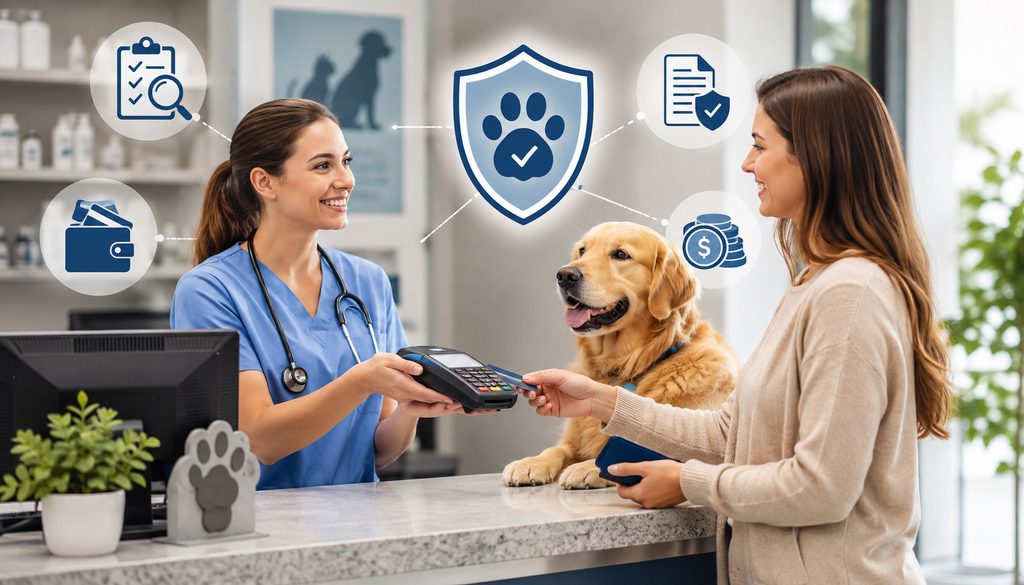
One of the most important points in veterinary checkout insurance is that direct pay does not mean the pet owner owes nothing.
An insurer usually pays only what the policy determines is eligible. Depending on the policy, the client may still be responsible for:
- deductible amounts;
- co-insurance or the non-reimbursed percentage;
- excluded veterinary expenses;
- charges exceeding applicable limits;
- services outside the covered benefit;
- non-covered fees;
- denied line items;
- amounts affected by policy conditions; and
- any remaining balance not paid by the insurer.
For example, imagine a veterinary treatment estimate of $4,000. The insurer’s pre-authorization process may suggest that a portion appears eligible, but the practice should not convert that preliminary figure into a guaranteed checkout balance.
The final procedure may involve additional diagnostics, medications, or hospitalization, and the insurer’s final adjudication may apply policy terms differently once all medical records and invoices are reviewed.
A safer checkout process is to identify three amounts:
- Final veterinary invoice
- Actual insurer payment
- Client payments already received
The reconciliation then becomes:
Final Veterinary Invoice − Insurer Payment − Payments Already Made = Remaining Client Balance
This is a useful operational formula, not a universal statement about legal liability. The practice’s agreement with the client, insurer program requirements, state law, and policy terms still matter.
The Direct-Pay Pet Insurance Timeline
The direct-pay pet insurance timeline is better understood as a series of financial checkpoints than as a promise that payment will arrive within a fixed number of hours or days.
A typical workflow may look like this:
- The practice prepares a veterinary treatment estimate.
- Staff collect or confirm the client’s insurance information.
- The client or practice determines whether direct pay is supported.
- Pre-authorization is requested if available and appropriate.
- The insurer reviews the proposed treatment information.
- Veterinary care is provided.
- The practice completes the final itemized invoice.
- The final claim and supporting records are submitted.
- The insurer adjudicates the claim.
- The insurer pays the approved amount.
- The practice reconciles the insurer payment with the invoice.
- The client pays any remaining balance or receives a verified refund.
There is no universal direct-pay pet insurance timeline. Carrier technology, the complexity of the case, medical-record requirements, claim completeness, practice participation, and policy review can all affect timing.
For example, Trupanion currently promotes an integrated system capable of processing many direct-payment claims very quickly at participating hospitals.
Pets Best’s direct-pay documentation, by contrast, describes payment after the claim has been processed. The examples show why a practice should not use one carrier’s timing as a promise for another carrier.
Practices that accept direct pay should record at least:
- claim submission date;
- claim number;
- insurer;
- expected insurer amount;
- client amount collected;
- approval status;
- insurer remittance date;
- outstanding client balance; and
- follow-up owner or staff member.
What Is Veterinary Pre-Authorization?
Veterinary pre-authorization, sometimes called pre-approval or pre-certification depending on the insurer, is a review of proposed veterinary treatment before that treatment is completed. It can help the policyholder and practice understand how the insurer currently views the proposed claim.
The terminology and legal effect are carrier-specific. A practice should therefore avoid treating “pre-authorization,” “pre-certification,” “coverage estimate,” and “claim approval” as interchangeable terms unless the insurer’s documentation says they are.
For example, Embrace describes its pre-certification process as a review of an itemized treatment or procedure estimate so the policyholder can understand coverage before treatment. Its published process requests an itemized estimate and diagnostic or treatment information and may involve relevant medical records.
That carrier example is useful because it shows what pre-authorization can accomplish operationally, but practices must still verify each insurer’s current procedures.
What Pre-Authorization Can Tell You
Depending on the insurer and policy, veterinary procedure pre-authorization may help clarify whether a proposed treatment appears eligible for coverage and what portion may potentially be reimbursable.
A response might provide information about:
- the proposed procedure’s apparent eligibility;
- estimated covered expenses;
- deductible status;
- reimbursement percentage or co-insurance;
- applicable policy limits;
- known exclusions;
- documentation requirements; or
- information the insurer still needs.
This information can improve a veterinary checkout insurance estimate and make financial discussions more useful. A client considering a scheduled orthopedic procedure, for example, may have more time to obtain a detailed treatment estimate and request an insurance review before the procedure.
The practice should preserve the written pre-authorization response with the client or claim record when appropriate. Staff should also document what was communicated to the owner and distinguish the insurer’s estimate from the practice’s treatment estimate.
What Pre-Authorization Cannot Guarantee
Pre-authorization should not automatically be treated as a guarantee of final claim payment unless the insurer’s written terms expressly provide that guarantee for the circumstances involved.
Final reimbursement can differ because of:
- a changed diagnosis;
- additional procedures;
- unexpected hospitalization;
- different medications or supplies;
- excluded invoice items;
- benefit limits;
- incomplete documentation;
- policy eligibility issues;
- medical history findings; or
- other claim-adjudication factors.
The final invoice may also differ materially from the original estimate. A surgical procedure estimated at three hours might require additional diagnostics or monitoring, or the veterinarian may reasonably alter the treatment plan based on the patient’s condition.
That is why staff should tell clients what the pre-authorization currently indicates, rather than saying, “Insurance has approved everything.”
Pre-authorization is not automatically a guarantee of final payment unless the insurer’s written terms expressly say so.
Veterinary Treatment Estimates and Insurance Estimates Are Different
Veterinary checkout becomes confusing when four different financial documents are treated as if they mean the same thing. They do not.
A veterinary treatment estimate is prepared by the practice and estimates what the recommended care may cost. An insurance pre-authorization or coverage estimate comes from the insurer and indicates how the policy may apply to the proposed care.
A final veterinary invoice records what the practice actually provided and charged. The final claim decision reflects the insurer’s adjudication of that completed claim.
| Document | Prepared By | What It Estimates or Records | Is It Final? |
| Veterinary treatment estimate | Veterinary practice | Expected treatment charges | No |
| Insurance pre-authorization estimate | Insurer | Expected policy treatment of proposed charges | Usually not the final claim payment |
| Final veterinary invoice | Veterinary practice | Actual services and charges | Final as to billed services, subject to later adjustments |
| Final claim decision | Insurer | Approved, adjusted, excluded, or denied claim amounts | Final for that adjudication unless reconsidered, appealed, or adjusted under applicable terms |
Practices should design their client communication around these differences. A treatment estimate answers, “What might the veterinary care cost?” The insurance estimate answers, “What might the insurer cover?” Neither answer necessarily establishes the final amount that will move between the insurer, owner, and practice.
A strong billing system should allow estimates, invoices, payments, credits, refunds, and receivables to remain distinguishable. The Veterinary Clinic Operations guide offers additional context on estimates, payment collection, financial policies, and reconciliation.
Deductibles, Reimbursement Percentages, Limits, and Exclusions
Pet insurance reimbursement calculations can look deceptively simple. A client may think, “My policy reimburses a percentage, so the insurer will pay that percentage of today’s total invoice.” Actual claim calculations can be more complicated.
At a conceptual level:
Illustrative Insurer Share = Eligible Covered Amount × Applicable Reimbursement Percentage
But the “eligible covered amount” may already have been affected by deductible provisions, exclusions, policy limits, benefit schedules, non-covered charges, or other policy rules. The order in which policy provisions apply is also policy-specific.
Pet Insurance Deductibles and Co-Insurance
Pet insurance deductibles do not use one universal design. A policy may use an annual deductible, a per-condition structure, or another arrangement permitted by the policy and applicable law.
Similarly, the pet insurance reimbursement percentage represents only one component of the calculation. If a policy reimburses a specified share of eligible expenses, the owner generally bears the remaining co-insurance portion in addition to other amounts the policy does not cover.
Practices should therefore avoid statements such as, “Your insurance pays 90%, so you owe 10%.” Even where 90% is the stated reimbursement percentage, other policy provisions can change the final arithmetic.
The safer approach is: “Your policy lists a reimbursement percentage, but your insurer determines the final eligible amount after applying the policy terms.”
Limits, Covered Expenses, and Pre-Existing Conditions
Policies may place annual, incident, condition-specific, or other benefit limits on reimbursement, but not every policy uses the same design. An invoice may also contain a mixture of potentially covered and non-covered veterinary expenses.
Examinations, diagnostics, surgery, medications, preventive services, elective procedures, rehabilitation, or other services should not be labeled universally covered or excluded. Eligibility depends on the actual policy.
Pre-existing-condition provisions deserve particular caution. The NAIC model defines a pre-existing condition using specified circumstances involving advice, treatment, or signs or symptoms before the policy effective date or during a waiting period, but state law and individual policy language must be checked before applying that definition to a specific claim.
Waiting periods may likewise apply after enrollment before certain coverage becomes effective. Practices should never invent a “standard” waiting period. Clients should be directed to their policy or insurer.
Pet Insurance Claims Workflow and Documentation
Once veterinary care is completed, the insurance process moves from estimation to evidence.
A typical veterinary claims workflow is:
Service Provided → Itemized Invoice → Medical Records → Claim Submission → Insurer Review → Additional Information if Needed → Claim Decision → Payment or Reimbursement
Claim submission does not mean claim approval. It simply starts or advances the insurer’s adjudication process.
Who submits the pet insurance claim varies. The policyholder may upload it through the insurer’s portal or app. A veterinary practice may fax, email, upload, or electronically transmit documentation with the client’s authorization. Some veterinary software integrations may automate portions of the process. A direct-pay carrier may also coordinate submission with the practice.
The practice should never assume it is legally responsible for filing a client’s insurance claim unless the relevant agreement or applicable requirement places that responsibility on the clinic.
Itemized Veterinary Invoice and Medical Records
Accurate itemization helps the insurer understand exactly what happened. Depending on the carrier, a veterinary invoice for an insurance claim may include:
- pet and owner information;
- date of service;
- description of each service or product;
- quantity;
- unit price;
- total charge;
- tax where applicable;
- discounts;
- credits;
- payments; and
- outstanding balance.
Embrace’s current claims documentation, for example, says its claims process requires an itemized invoice and diagnosis or reason for visit, and its first-claim process can also require medical history. This should be treated as a carrier-specific example, not a universal checklist.
Medical records may help an insurer evaluate diagnosis, symptom history, prior conditions, treatment rationale, and other policy questions. Practices should transmit records through appropriate channels and follow applicable privacy, security, recordkeeping, and client-authorization requirements.
Missing Documentation and Claim Delays
Missing information does not automatically mean a claim will be denied. It may simply prevent the insurer from finishing its review.
Examples include:
- incomplete invoice pages;
- missing diagnosis or reason for visit;
- incomplete medical history;
- unreadable documentation;
- mismatched patient information; or
- missing authorization.
One carrier’s published claim-status guidance, for example, identifies missing medical history, diagnosis information, and complete invoices as reasons a claim may remain pending or be placed on hold.
For a direct-pay practice, these delays matter financially because the claim may represent unpaid accounts receivable. Missing documentation should therefore trigger a workflow task—not simply an assumption that “the insurance company is taking a long time.”
Claim Adjudication, Partial Approval, and Denials
Claim adjudication is the insurer’s process of comparing the claim against the policy and deciding what, if anything, is payable.
Possible outcomes include:
- full approval;
- partial approval;
- request for additional information;
- adjustment;
- denial; or
- another disposition permitted under the policy.
Claim approval and receipt of funds are separate operational events. A practice may receive confirmation that a claim is approved before the insurer’s payment appears in the bank account. Direct-pay veterinary practices should reconcile actual funds rather than posting an expected payment as though it has already arrived.
A pet insurance claim denial may involve an exclusion, pre-existing-condition determination, waiting-period issue, non-covered service, policy limit, lapse, missing information, or another contractual reason. These are categories of possible outcomes, not statements that every insurer uses the same rules.
Partial approvals are especially important at checkout. If an insurer pays only certain lines of a $2,500 invoice, the veterinary practice must determine what remains open rather than assuming the original estimated client portion was correct.
Operationally:
Final Veterinary Invoice − Insurer Payment − Payments Already Made = Remaining Client Balance
If the client believes the insurer adjudicated the claim incorrectly, the client may need to use the insurer’s reconsideration or appeal process. Where a regulatory problem remains unresolved, the client can consult the appropriate state insurance department.
Veterinary Collections Under Reimbursement and Direct Pay
Insurance changes collections most dramatically when the practice agrees to wait for insurer funds.
Under reimbursement:
Practice collects from client → insurer later reimburses client
This generally keeps claim-processing timing outside the practice’s accounts receivable. The client might pay by card, ACH, cash, approved financing, or another method accepted by the clinic. Payment plans may also be available under the practice’s policies.
Under direct pay:
Practice may collect estimated client share → insurer claim becomes an expected practice payment → claim is adjudicated → final balance is reconciled
That model can improve client cash flow but introduces insurer-related receivables.
Written Direct-Pay Collections Policy
A veterinary direct-pay insurance policy for the practice should address:
- whether the clinic accepts direct pay;
- which insurer programs are supported;
- whether client authorization is required;
- whether a deposit is collected;
- how the estimated client share is calculated;
- who follows pending claims;
- what happens after partial approval;
- what happens if the claim is denied;
- when the client becomes responsible for an unpaid balance;
- how delayed claims are handled;
- how treatment changes affect the estimate; and
- how refunds are issued after reconciliation.
The policy should also define when an insurer receivable becomes a client receivable. Staff should not improvise that decision at the front desk.
A practice evaluating these issues can use veterinary practice KPI and accounts-receivable guidance to build a more disciplined aging and collections process.
Should the Practice Wait for Insurance Payment?
There is no universal answer. The decision depends on the carrier arrangement, practice policy, amount, treatment type, claim status, direct-pay agreement, client relationship, applicable law, and the clinic’s tolerance for accounts-receivable exposure.
A practice should not extend credit casually simply because a client has pet insurance. Insurance coverage may reduce expected client cost without eliminating claim uncertainty.
Emergency care creates additional considerations. Medical decisions should not be improperly delayed solely to complete administrative insurance verification when immediate veterinary attention is necessary.
For scheduled or elective procedures, however, additional time may allow the practice and client to obtain estimates, evaluate payment options, and request pre-authorization where available.
Deposits, Estimated Client Portions, and Final True-Up
In a direct-pay workflow, a veterinary practice may choose to collect a deposit or estimated client responsibility before treatment, subject to its financial policy and applicable requirements.
A practical estimate might consider:
Estimated Deductible + Estimated Co-Insurance + Known Non-Covered Charges
That number should be presented as provisional. The final amount may change when the insurer adjudicates the completed claim.
Imagine a practice collects $900 from a client based on the available insurer estimate. After treatment, the invoice changes and the insurer ultimately pays more than expected. The client’s account may then show a true overpayment.
The practice should:
- Confirm that the insurer payment has actually cleared.
- Match the payment to the correct claim and invoice.
- Review any insurer remittance or explanation.
- Verify adjustments and prior client payments.
- Calculate the true remaining balance or credit.
- Issue any refund according to practice policy and applicable requirements.
If the insurer pays less than expected, staff should determine why before asking the client for additional funds. The difference could result from a denied line item, policy limitation, documentation problem, insurer processing issue, or legitimate client responsibility.
That investigation is especially important when the difference is substantial.
Direct-Pay Accounts Receivable and Reconciliation
Direct-pay pet insurance can turn part of a veterinary invoice into an insurer-related accounts receivable. That makes claim tracking a finance function as well as a client-service function.
A useful insurer A/R report might look like this:
| Claim/Invoice | Insurer | Submitted | Approved Amount | Insurer Paid | Client Balance | Days Outstanding |
| INV-2148 | Carrier A | Date recorded | $1,800 | $0 | $525 | 5 |
| INV-2162 | Carrier B | Date recorded | $650 | $650 | $100 | 0 |
| INV-2187 | Carrier C | Date recorded | Pending | $0 | $300 | 12 |
The purpose is not to impose an arbitrary aging benchmark. It is to make unresolved claims visible.
The full reconciliation workflow should be:
Final Invoice → Client Payment → Claim → Insurer Remittance → Bank Deposit → Practice Management System → Accounting
A second reconciliation table can help:
| Invoice | Client Paid | Insurer Expected | Insurer Received | Adjustment | Remaining Balance |
| $2,500 | $600 | $1,900 | $1,750 | $0 | $150 |
Insurer payments should be matched to the correct patient, client, invoice, claim number, and date of service. If an insurer sends one batch deposit covering several claims, the finance team should use the remittance detail to allocate each component correctly.
Veterinary software can help organize these workflows. The Veterinary Software Buying Checklist discusses estimates, invoice management, payment posting, refunds, accounts receivable, and reporting considerations relevant to this process.
Duplicate Payments, Refunds, Reversals, and Accounting
Pet-insurance workflows create a particular duplicate-payment risk.
Suppose a client pays the entire $3,000 veterinary invoice at checkout because direct payment was uncertain. Later, the insurer sends $2,000 directly to the practice instead of reimbursing the policyholder. The clinic now holds more money than the invoice requires unless one of those payments is reversed, reallocated, or otherwise adjusted.
A daily or weekly reconciliation routine should look for:
- client-paid invoices that later receive insurer funds;
- duplicate claim payments;
- insurer deposits without matching claims;
- refunds issued before remittance was received;
- credit balances;
- reversed insurer payments; and
- claim adjustments after initial posting.
Insurers may also adjust claim outcomes according to their policies and procedures. Practices should therefore avoid treating preliminary expected insurance amounts as irrevocable accounting entries.
At a high level, the accounting system should distinguish among:
- client receivable;
- insurer receivable;
- client payment;
- insurer payment;
- refund;
- claim or billing adjustment; and
- write-off or other accounting treatment.
The proper financial-statement treatment depends on the practice’s facts, contracts, and accounting policies. A qualified accountant should advise on material financial-reporting questions.
Emergency Care, Scheduled Procedures, and Treatment Changes
Insurance administration fits differently into an emergency visit than into a scheduled procedure.
During an emergency, waiting for a pre-authorization response may be impractical or medically inappropriate. A practice can still explain estimated charges, obtain financial consent when feasible, collect required payment according to its policy, and assist with insurance documentation afterward.
Scheduled procedures generally offer more planning time. Before an elective or non-emergency procedure, the team may be able to:
- prepare a detailed treatment estimate;
- confirm the insurer and policy information;
- determine whether direct pay is available;
- request pre-authorization;
- discuss financing or payment options;
- obtain financial consent; and
- explain how additional treatment could change the final balance.
Treatment changes deserve special attention. A procedure may reveal an unexpected clinical finding that requires another diagnostic test, medication, hospitalization day, or service. Even a detailed pre-authorization cannot necessarily predict those changes.
The practice’s financial consent process should therefore explain that the treatment estimate and insurance estimate may change. Staff should also define how the client will be contacted when the cost exceeds an agreed threshold, except where urgent clinical circumstances require immediate action within the bounds of consent and applicable professional obligations.
Client Communication and Financial Consent
The quality of a pet insurance checkout process depends heavily on what staff say before treatment.
Clients should understand:
- the veterinary treatment estimate;
- any available insurer estimate;
- the amount the practice expects at checkout;
- whether direct pay has actually been arranged;
- that final claim adjudication may change insurance payment;
- that the client may owe additional amounts;
- how credits or overpayments will be refunded; and
- what happens if an insurer delays or denies payment.
A useful front-desk explanation is:
“Your insurer has provided an estimate based on the information currently available. The final benefit is determined after the completed claim is reviewed. We’ll collect the amount currently estimated as your responsibility and reconcile any difference after the final claim and payment are processed.”
Financial consent should remain separate from assumptions about insurance reimbursement. A client authorizing veterinary care should understand the practice’s financial terms even if insurance is expected to contribute.
Where a carrier requires direct-pay authorization, reimbursement release, or an assignment mechanism, the practice should use the carrier’s current documentation and confirm applicable state requirements.
Pets Best’s current direct-pay release, for example, expressly states that the request does not guarantee claim payment and that the policyholder remains responsible for outstanding balances.
Payment Plans, Cards, Card-on-File, and PCI DSS
Pet insurance does not replace other payment options. Even an insured client may need to fund a deductible, co-insurance amount, excluded service, or full invoice while waiting for reimbursement.
Depending on the practice, clients may use:
- credit or debit cards;
- ACH or bank-based payments;
- savings;
- third-party financing;
- approved practice payment plans; or
- another accepted payment method.
Veterinary practices accepting cards should follow applicable PCI DSS requirements and their payment provider’s procedures. Payment systems should minimize unnecessary handling of card data, restrict access appropriately, and use secure tools such as approved terminals, tokenized stored credentials, and secure payment links where supported.
Sensitive authentication data deserves particular care. PCI guidance prohibits storing card verification codes such as CVV/CVC/CID after authorization. Practices should not ask clients to send complete payment-card information through ordinary email or store card data in unapproved notes.
A tokenized card-on-file arrangement can simplify collection of a final client balance after insurance adjudication, but a stored credential does not authorize arbitrary charges. The practice should obtain appropriate consent, follow processor/card-network requirements, disclose when and why future charges may occur, and provide receipts.
The PCI Security Standards Council’s guidance on tokenization and protection of payment-card data can help practices understand why properly designed payment systems reduce exposure.
Veterinary Software, Claims Automation, and Payment Matching
Technology can make veterinary insurance claims easier to manage, but automation should support—not replace—accurate clinical and financial records.
A practice-management or claims integration may help with:
- itemized invoice generation;
- electronic claim submission;
- document attachment;
- claim-status tracking;
- direct-pay workflows;
- payment posting;
- insurer A/R reporting; and
- reconciliation.
Every claim should have reliable matching identifiers. Useful fields include:
- pet/patient ID;
- client/owner ID;
- invoice number;
- claim number;
- insurer;
- policy identifier where appropriate;
- date of service; and
- insurer payment reference.
These identifiers become especially important when one insurer deposit contains several veterinary insurance payments. Without remittance-level matching, a finance team can easily post $5,000 to the bank account while leaving five underlying invoices incorrectly open.
Claims automation also has limits. Software cannot safely infer missing diagnoses, rewrite medical histories to improve eligibility, or assume a charge is covered merely because it appears on an invoice.
Practices evaluating system design should consider how veterinary practice management software connects financial reporting and accounts receivable, especially when insurance-related balances are growing.
Insurance Verification and Front-Desk Staff Training
Insurance verification at check-in should be an information-gathering process, not a coverage promise.
Staff may reasonably collect or verify:
- insurer name;
- policyholder;
- pet covered;
- policy number;
- direct-pay availability;
- direct-pay enrollment requirements;
- pre-authorization status;
- claim contact information; and
- documentation requirements.
Staff should know the difference among six terms:
Estimate → Authorization → Claim → Approval → Payment → Remaining Balance
Confusing any two can create payment disputes.
Front-desk employees should never promise:
- “Insurance will definitely cover this.”
- “You’ll only owe 10%.”
- “The pre-authorization guarantees payment.”
- “There is no chance this will be denied.”
- “Your insurer pays the entire balance.”
- “The claim is paid” when it has only been submitted or approved.
A consistent veterinary insurance checkout workflow is safer:
- Create the treatment estimate.
- Ask whether the pet is insured.
- Determine reimbursement versus direct-pay workflow.
- Request pre-authorization when appropriate and available.
- Explain the limitations of insurance estimates.
- Collect the required client amount.
- Provide veterinary care.
- Finalize the itemized invoice.
- Submit or assist with the claim.
- Monitor direct-pay claims.
- Post actual insurer payment.
- Reconcile the account and refund or collect any difference.
AAHA resources emphasize the importance of structured financial conversations and written treatment plans when clients face veterinary costs.
Practice Financial Policy and Claim Documentation Checklist
A written financial policy turns a difficult checkout conversation into a repeatable business process.
The policy should explain:
- when payment is due;
- whether the practice assists with insurance claims;
- whether direct-pay programs are accepted;
- which direct-pay arrangements require advance approval;
- deposit requirements;
- client responsibility for unpaid balances;
- procedures after claim denial or partial approval;
- how delayed claims are handled;
- refund procedures;
- treatment-estimate limitations;
- stored-payment authorization where used; and
- consequences for unpaid balances consistent with applicable law.
Direct-pay arrangements should also be reviewed from a cash-flow perspective. When a practice provides care before receiving insurer funds, it is effectively choosing to carry a receivable. That decision should be intentional.
A practical documentation checklist is:
| Document | Purpose |
| Treatment estimate | Records expected veterinary charges |
| Final itemized invoice | Records actual services and charges |
| Medical record | Supports diagnosis and treatment history |
| Diagnosis/procedure notes | Helps explain the clinical basis of the claim |
| Claim form | Initiates or documents claim submission where required |
| Pre-authorization | Records insurer’s pre-service review |
| Payment receipt | Confirms client payment |
| Insurer remittance | Supports posting and reconciliation |
Measuring Pet Insurance Operations and Avoiding Common Mistakes
Practices do not need arbitrary industry benchmarks to manage pet insurance effectively. They need consistent internal measurement.
Useful operational metrics include:
- number of insurance-related invoices;
- number of direct-pay claims;
- claim turnaround by carrier or workflow;
- pending-document requests;
- insurer accounts receivable;
- client accounts receivable;
- partial approvals;
- denials;
- credit balances;
- refund adjustments; and
- claims requiring manual rework.
The goal is to identify friction. If one insurer’s direct-pay claims frequently remain open because a particular document is missing, the practice may be able to improve its submission checklist. If refunds are frequently required because staff collect too much at checkout, the practice may need better estimated procedures.
Common veterinary checkout mistakes include:
- promising coverage before adjudication;
- confusing an estimate with a final approval;
- assuming direct pay means zero due;
- failing to account for deductibles or co-insurance;
- treating all insurers alike;
- failing to track insurer A/R;
- posting expected insurance money before it arrives;
- failing to reconcile client and insurer payments;
- submitting incomplete invoices;
- omitting requested medical records;
- refunding before insurer payment is reconciled;
- delaying urgent veterinary decisions solely for insurance administration; and
- charging a stored card later without appropriate authorization.
Practices should periodically review these exceptions with front-desk, billing, management, and finance staff.
Questions Practices Should Ask Before Accepting Direct-Pay Insurance
Before adding a direct-pay carrier or program to the veterinary checkout process, the practice should understand exactly what operational commitment it is making.
Ask the insurer:
- Does the veterinary practice need to enroll?
- Which claims qualify for direct pay?
- Is pre-authorization required?
- Who submits the claim?
- What documentation is required?
- Does the client need to sign a reimbursement release or other authorization?
- How is the estimated client portion calculated?
- Who receives the final claim decision?
- How are partial approvals handled?
- How are insurer payments remitted?
- Is remittance detail available for batch payments?
- What happens if the final invoice differs from the estimate?
- How are denied claims handled?
- Can an insurer payment or claim decision later be adjusted?
- What procedure should the practice follow for client refunds?
The answer to these questions should become part of the practice’s written carrier profile. Staff should not rely on memory, especially when several insurers use different procedures.
Carrier instructions should also be reviewed periodically because claims portals, direct-pay options, documentation requirements, and policy forms can change.
Frequently Asked Questions
How does pet insurance work at veterinary checkout?
Pet insurance does not necessarily pay the veterinary hospital when the client leaves. Under a reimbursement policy, the pet owner generally pays the practice and later submits a claim to the insurer. Under some direct-pay arrangements, an approved insurer payment may instead be sent to the veterinary practice.
The amount due at checkout depends on the practice’s financial policy, insurer arrangement, policy terms, treatment, and claim status. Pet owners should not assume having insurance eliminates an upfront payment requirement.
What is the difference between direct-pay and reimbursement pet insurance?
With reimbursement pet insurance, the client typically pays the veterinary practice first and receives the approved reimbursement from the insurer later.
With direct-pay pet insurance, the insurer may send the approved claim amount directly to the veterinary practice. The client can still owe deductibles, co-insurance, exclusions, amounts above limits, denied services, and other unpaid charges.
Does a veterinary practice have to accept direct-pay pet insurance?
Not necessarily. Direct-pay availability can depend on the insurer’s program, practice participation requirements, client authorization, applicable agreements, and the clinic’s own financial policy.
A practice should review the carrier’s current terms before agreeing to hold an invoice open for insurer payment. Clients should confirm direct-pay availability before assuming their veterinary hospital participates.
Does direct pay mean the pet owner owes nothing at checkout?
No. Direct pay describes where the insurer sends its approved payment; it does not mean the insurer pays the full veterinary bill.
The client may remain responsible for deductibles, co-insurance, excluded services, benefit-limit differences, non-covered charges, partially approved items, or other balances under the policy and practice agreement.
What is veterinary insurance pre-authorization?
Veterinary pre-authorization or pre-certification is a carrier-specific review of proposed veterinary treatment before the service is completed.
Depending on the insurer, it may help identify whether the proposed care appears eligible, estimate insurance benefits, or identify additional information needed. The exact terminology and effect depend on the insurer and policy.
Does pre-authorization guarantee pet-insurance coverage?
Not automatically. Final claim payment may change because the diagnosis changes, additional treatment is provided, the final invoice differs, documentation reveals new information, exclusions or limits apply, or other policy conditions affect adjudication.
A practice should treat pre-authorization as an insurer’s pre-service determination or estimate according to that carrier’s written terms—not as a universal guarantee.
How long does direct-pay pet insurance take?
There is no universal direct-pay pet insurance timeline. Some integrated systems may make eligible claim decisions very quickly, while other direct-pay arrangements require completion of the normal claims review first.
Practices should check the insurer’s current documentation and avoid promising clients a specific turnaround time unless the carrier has provided one that applies to the particular claim.
Who submits a pet-insurance claim?
It varies. The pet owner may submit the claim through an insurer’s website or app. A veterinary practice may assist or submit documents, and some integrated direct-pay workflows allow the practice to transmit the claim.
The veterinary practice should not assume responsibility for claim filing unless its agreement or workflow clearly assigns that task.
What documents are needed for a veterinary insurance claim?
Common documentation can include an itemized veterinary invoice, diagnosis or reason for visit, medical records, treatment notes, claim forms, and proof of payment where required.
Requirements differ by insurer and type of claim. Practices and pet owners should follow the carrier’s current claim instructions rather than assuming one checklist applies to every policy.
Can the final insurance payment differ from the checkout estimate?
Yes. A treatment estimate, insurer pre-authorization estimate, final veterinary invoice, and final claim decision represent different stages of the process.
Treatment may change, additional services may be required, or policy provisions may alter the eligible amount. Practices should therefore describe insurance figures at checkout as estimates when they have not been finally adjudicated.
What happens if pet insurance only partially covers the invoice?
The practice should first reconcile the insurer’s actual payment against the final invoice and the client’s existing payments.
Any remaining balance should then be evaluated according to the practice’s financial agreement, the insurer’s explanation, policy terms, and applicable requirements. The client may be responsible for the difference, but staff should understand why the claim was partially paid before collecting additional amounts.
Who owes the balance if a direct-pay claim is denied?
The answer depends on the financial agreement between the veterinary practice and the client, the carrier’s direct-pay terms, applicable law, and the reason for denial.
Practices should address this situation in writing before treatment whenever possible. A direct-pay arrangement should not leave staff and clients discovering after a denial that they had different assumptions about responsibility.
Can a veterinary practice collect from the client while a claim is pending?
A practice may require payment, a deposit, or the estimated client portion according to its financial policy and applicable law, but the details depend on the direct-pay arrangement and client agreement.
Practices should avoid representing an estimated insurance contribution as guaranteed and should clearly explain how any later overpayment or shortfall will be reconciled.
How should veterinary practices reconcile insurer and client payments?
Match the final invoice to every client payment, insurer payment, claim adjustment, credit, and refund.
A practical sequence is:
Invoice → Client Payment → Claim → Insurer Remittance → Bank Deposit → Account Posting → Final Balance
Do not issue a refund or close an invoice until actual insurer funds and client payments have been reconciled.
What should front-desk staff say about estimated pet-insurance coverage?
Staff should describe what is known without promising the final outcome.
A useful explanation is: “The insurer’s current estimate indicates that part of this treatment may be eligible, but the final benefit is determined when the completed claim is reviewed. We’ll show you what is estimated as your responsibility today and reconcile the account after the final insurance payment.
Conclusion
Pet insurance at checkout works best when a veterinary practice treats insurance as a payment workflow, not as a promise that somebody else will pay the bill.
Traditional reimbursement generally keeps the structure simple: the practice collects from the client, and the insurer later reimburses the policyholder for eligible expenses. Direct-pay pet insurance can reduce the client’s upfront cash requirement, but it can also move part of the collection risk and administrative workload onto the veterinary practice.
Pre-authorization can improve financial planning, but it should not be confused with the final claim decision unless the insurer’s written terms expressly give it that effect. The veterinary treatment estimate, insurance estimate, final invoice, and final adjudication should remain clearly separated.
For practices, the strongest system combines accurate itemized invoices, consistent financial consent, carrier-specific direct-pay procedures, documented client authorization, disciplined insurer A/R tracking, secure payment collection, and final reconciliation of every dollar received.
For pet owners, the key question is not simply, “Do I have insurance?” It is: How does my policy interact with this veterinary practice’s checkout process, what might I owe now, and what remains subject to final claim review?
When both sides understand those answers before treatment whenever circumstances allow, pet insurance can support access to veterinary care without creating unnecessary billing confusion afterward.
Informational disclaimer: This article provides general veterinary business, insurance-workflow, payment, and collections information. It is not veterinary medical, insurance, legal, accounting, or financial advice.
Pet-insurance policies, insurer procedures, direct-pay programs, and state requirements vary. Practices and policyholders should review the applicable policy, carrier documentation, agreements, payment-provider requirements, and state insurance rules, and obtain qualified professional advice when appropriate.