
DEA Controlled-Substance Logs and Inventory Reconciliation: Biennial Counts, Discrepancy Investigations, Audit Readiness
Controlled-substance inventory errors often begin as small documentation gaps—a missed administration entry, an incorrect quantity received, an undocumented waste event, or a unit-of-measure mistake.
Left unresolved, those gaps can make a routine DEA inventory or audit far more difficult because the veterinary practice can no longer clearly explain where controlled substances went.
The safest approach is continuous record accuracy rather than last-minute audit preparation. DEA Controlled-Substance Logs and Inventory Reconciliation should connect every important movement of controlled drugs: purchase or receipt, secure storage, administration or dispensing, record entry, physical counting, variance review, discrepancy investigation, required reporting, and corrective action.
A useful compliance framework is:
Purchase/Receipt → Secure Storage → Administration/Dispensing → Record Entry → Physical Count → Expected Inventory → Variance Review → Documented Investigation → Required Reporting/Correction → Periodic Audit
Inventory reconciliation is more than a DEA biennial count. A biennial inventory is a formal regulatory snapshot, while reconciliation is the operational process of determining whether receipts, administration, dispensing, waste, transfers, returns, destruction, and physical stock can be reasonably accounted for through reliable records.
Federal DEA rules provide the baseline. State controlled-substance laws, veterinary-board regulations, pharmacy laws, and facility-specific requirements may impose additional or stricter obligations. Practices should therefore treat federal compliance as one layer of a broader veterinary controlled-substance compliance program.
DEA Controlled-Substance Recordkeeping Basics
Veterinary practices that handle controlled substances may generate several categories of records. Depending on the activity involved, these can include inventories, purchasing and receiving documents, Schedule II order records, dispensing records, administration records, transfer documentation, destruction records, returns, and theft or significant-loss reports.
Federal recordkeeping obligations depend partly on the registrant’s activities. For example, 21 CFR Part 1304 establishes inventory and record requirements, while 21 CFR Part 1305 governs orders for Schedule I and II controlled substances. DEA regulations also distinguish prescribing, administering, and dispensing rather than treating them as interchangeable activities.
A registered individual practitioner is required to maintain records of Schedule II–V controlled substances dispensed other than by prescribing or administering in the lawful course of professional practice.
Federal regulations also contain specific circumstances under which administration records are required, including when a practitioner regularly engages in dispensing or administering controlled substances and charges patients for those substances. State veterinary or pharmacy rules may impose broader requirements.
The main records a veterinary practice may need to organize include:
- initial and biennial inventories;
- supplier invoices and receiving records;
- Schedule II DEA Form 222 or electronic CSOS records;
- administration and dispensing documentation;
- transfer and return records;
- destruction documentation where applicable;
- DEA Form 106 reports for theft or significant loss;
- supporting medical and patient records; and
- internal reconciliation and discrepancy-investigation records.
Not every internal log is independently mandated by federal law. A receiving log, perpetual inventory sheet, discrepancy log, dual-count form, or management dashboard may instead be an internal control used to make federally required records more reliable.
Practices seeking broader operational structure can also review this guide to veterinary clinic operations and compliance workflows, which discusses documented procedures, training, inventory, and compliance awareness.
What Is a Controlled-Substance Inventory?
A controlled-substance inventory is a documented physical accounting of controlled drugs on hand. For DEA-required inventories, the inventory must be complete and accurate and include controlled substances that are in the possession or under the control of the registrant at the time of the inventory.
Several records that practices commonly call “inventory” actually serve different functions.
A physical inventory records what is physically on hand at a particular point in time. An initial inventory establishes the DEA registrant’s starting position when the registrant first engages in controlled-substance activity, while a biennial inventory is the recurring federal inventory required at least every two years.
A perpetual inventory continuously calculates the theoretical balance after each receipt and disposition. It can be extremely valuable for identifying discrepancies early, but federal regulations do not universally require every veterinary practitioner to maintain a perpetual log for every Schedule II–V substance.
Purchase records establish what came into the practice. Administration and dispensing records document lawful use or disposition. Reconciliation connects those records to physical stock.
In practical terms:
Physical count = what the practice actually has.
Expected balance = what the records say the practice should have.
Reconciliation = determining whether those two numbers reasonably agree and, when they do not, finding out why.
This distinction matters because a practice can complete its formal DEA controlled substance inventory on schedule and still have weak day-to-day controls. A physical snapshot taken every two years does not automatically explain losses, late documentation, unrecorded waste, or receiving errors that occurred months earlier.
Initial and Biennial DEA Controlled-Substance Inventories
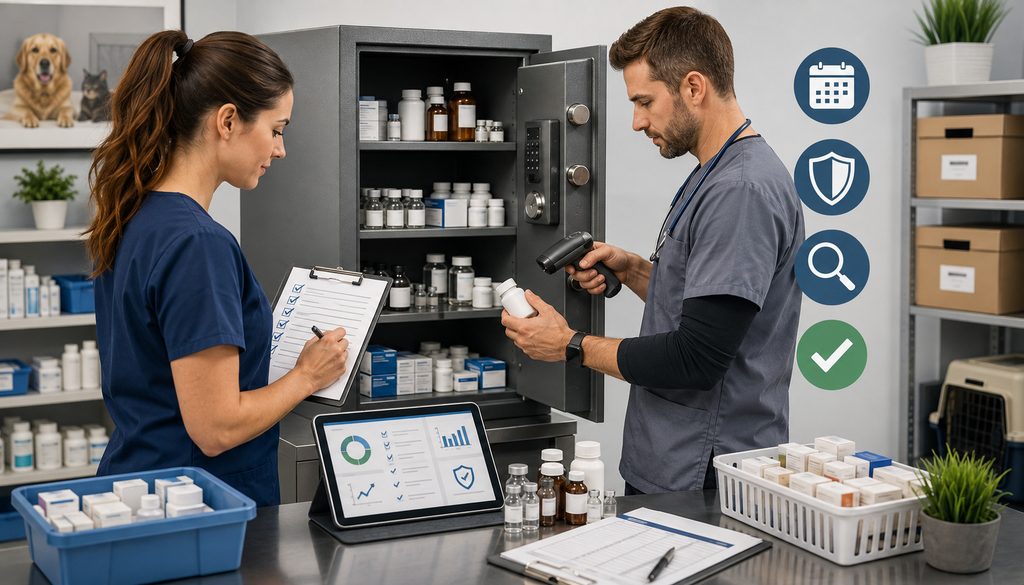
DEA regulations require every person subject to the inventory rules to take an initial inventory of controlled substances on hand on the date the person first engages in the manufacture, distribution, or dispensing of controlled substances. If there are no controlled substances on hand when business begins, that fact must still be recorded as the initial inventory.
The inventory is taken as of either the beginning or close of business, and the record must identify which timing applies. Separate inventories are required for each registered location and independent registered activity subject to the applicable rules.
Practices should review the current text of 21 CFR 1304.11 inventory requirements before adopting or revising an inventory procedure.
DEA Biennial Inventory
After the initial inventory, the registrant must take a new inventory of controlled substances on hand at least every two years. The biennial inventory may be taken on a date that falls within two years of the previous required inventory.
A DEA biennial count is a physical inventory. The inventory date must reflect the actual date of the count, and the record should indicate whether the inventory was taken at the beginning or close of business.
For finished controlled substances, the inventory rules call for information such as the substance name, finished form or strength, number of units or volume in each commercial container, and number of commercial containers. These details allow the inventory record to identify exactly what was counted rather than merely stating that a particular drug was “in stock.”
A practice should not recreate a missed biennial inventory by backdating a document. If a required inventory was not performed, management should preserve the actual records, establish what happened, consult appropriate compliance or legal advisors, and determine the proper corrective response.
Schedule II and Schedule III–V Count Rules
For dispensers and researchers, an opened container of a Schedule I or Schedule II controlled substance requires an exact count or measure during the DEA inventory.
For an opened commercial container of a Schedule III, IV, or V substance, an estimated count or measure is generally permitted under the federal inventory rule. However, if the container holds more than 1,000 tablets or capsules, an exact count is required.
Practices may deliberately require exact counts more broadly as an internal control even when federal law permits estimation. State rules may also establish additional counting requirements.
Biennial Count Versus Ongoing DEA Inventory Reconciliation

The most important operational distinction is:
Biennial Inventory = formal regulatory snapshot
Ongoing Reconciliation = process for testing whether the records explain the physical stock
A practice that waits until the next DEA biennial count to discover a controlled-substance discrepancy may have to review years of invoices, administration records, dispensing transactions, transfers, waste events, and inventory adjustments.
Even a minor recurring documentation problem can become difficult to reconstruct after staff turnover or software changes.
A practical controlled drug reconciliation starts with:
Expected Inventory = Opening Inventory + Verified Receipts − Documented Administration − Documented Dispensing − Authorized Waste − Transfers/Returns/Destruction
Then calculate:
Variance = Physical Count − Expected Inventory
This formula is an internal reconciliation framework, not a replacement for the specific records required by federal or state law.
A variance of zero does not automatically prove every transaction was handled correctly. For example, two offsetting errors could produce a mathematically correct final balance. Reconciliation should therefore evaluate both quantity and supporting documentation.
The reverse is also true: a variance does not automatically prove theft or diversion. A genuine receiving mistake, duplicate entry, wrong unit conversion, unposted transfer, or physical count error may explain it.
The appropriate response is investigation, not assumption.
Practices can choose daily, weekly, monthly, or risk-based reconciliation intervals depending on controlled-drug volume, prior discrepancies, state requirements, staffing, and internal policy. More frequent counts are generally easier to investigate because fewer transactions fall between the last confirmed balance and the current count.
Controlled-Substance Logs and Inventory Records

A well-designed veterinary controlled-substance recordkeeping system usually contains both legally required records and additional internal control logs. The objective is to create a reliable chain of custody and disposition without confusing internal policy with federal law.
Common veterinary controlled substance logs include:
- controlled drug receiving log;
- perpetual inventory log;
- dispensing record;
- administration record;
- waste or remainder documentation;
- transfer and return record;
- destruction documentation;
- discrepancy investigation log; and
- physical count sheets.
The federal inventory record itself is governed by DEA inventory regulations. Separate continuing records may be required for dispensing, administration, receipt, destruction, and other transactions depending on the registrant’s activity.
Inventory Record Elements
| Record Element | Why It Matters | Federal Requirement or Best Practice? |
| Drug name | Identifies the controlled substance | Required for DEA inventory |
| Strength/finished form | Distinguishes different formulations | Required for applicable finished-form inventory |
| Dosage form | Prevents tablets, liquids, injectables, or other forms from being combined incorrectly | Part of finished-form identification |
| Quantity or volume | Establishes stock on hand | Required |
| Commercial-container information | Describes units/volume per container and number of containers | Required for applicable finished-form inventory |
| Inventory date | Establishes when the count occurred | Required |
| Beginning or close of business | Establishes the inventory point | Required |
| Schedule | Helps organize and segregate records | Strong operational control; schedule-specific rules still apply |
| Storage location | Helps locate and reconcile stock | Best practice unless otherwise required by applicable law |
| Counter/reviewer | Improves accountability | Best practice unless state or other applicable rules require it |
| Variance explanation | Documents investigation | Best practice; separate reporting duties may apply to losses |
Perpetual Inventory
A controlled substance perpetual inventory updates an expected running balance after every receipt and disposition.
For example:
Beginning balance + receipts − administrations − dispensing − documented waste − transfers = expected balance
The advantage is speed. If yesterday’s balance is reconciled and today’s does not, investigators generally have a much smaller set of transactions to examine.
A perpetual inventory should not be treated as self-validating. Automated inventory systems can reproduce incorrect data very efficiently if staff choose the wrong medication, wrong strength, wrong unit, or wrong patient record.
Practices evaluating electronic systems may find this veterinary software buying checklist for inventory and audit controls useful when reviewing role permissions, inventory tracking, audit trails, and controlled-substance documentation.
Receiving, Schedule II Ordering, Administration, and Dispensing
Controlled-substance reconciliation becomes much easier when documentation begins at receiving rather than when medication is first used. Staff should compare what was physically delivered with the supplier invoice, packing documentation, purchase order, and any controlled-substance ordering record that applies.
A useful receiving control is to verify the exact drug, strength, dosage form, package size, quantity, and actual receipt date before entering stock into the inventory system. The person receiving the shipment should not simply assume the supplier shipped what the purchase order requested.
Schedule II Ordering and DEA Form 222
Orders for Schedule I and II controlled substances generally require a DEA Form 222 or a qualifying digitally signed electronic order under DEA’s Controlled Substance Ordering System, subject to regulatory exceptions. The current federal ordering requirements are set out in 21 CFR Part 1305.
For paper Form 222 transactions, the purchaser retains a copy and records on it the number of commercial or bulk containers furnished and the dates the containers are received. Electronic orders similarly require the purchaser to create a record of the quantity of each item received and the date received, electronically linked to the original order.
DEA’s CSOS functions as the electronic equivalent for controlled-substance ordering, and DEA continues to support paper Form 222 ordering.
The practice should protect Form 222 and electronic ordering authority carefully and ensure only properly authorized individuals execute orders.
Administering, Dispensing, and Prescribing Are Different Activities
Administering generally means directly applying a controlled substance to the animal under appropriate professional authority. Dispensing means delivering a controlled substance to the ultimate user or otherwise supplying it for later use.
Prescribing authorizes medication to be dispensed but does not itself necessarily represent movement of inventory from the veterinary practice.
This distinction matters because the federal recordkeeping rules differ by activity.
For dispensers, 21 CFR 1304.22(c) includes records of the number of units or volume dispensed and information identifying the recipient, dispensing date, and individual who dispensed or administered the substance on behalf of the dispenser.
A veterinary practice’s internal administration log will often capture patient, drug, strength, amount administered, date or time, clinician, and inventory balance. State veterinary-board and controlled-substance rules may require additional fields, so practices should not assume federal requirements are the entire recordkeeping standard.
Waste, Returns, Destruction, and Transfers
Controlled-substance waste can occur legitimately when, for example, a medication prepared for immediate administration is not completely exhausted or a product can no longer be used. The documentation and destruction requirements depend on the circumstances, so practices should avoid applying one universal “waste rule” to every situation.
Federal regulations specifically address destruction of controlled substances dispensed for immediate administration at a practitioner’s registered location when some medication remains and cannot or may not be further utilized.
That remainder must be properly recorded under the dispenser recordkeeping requirements, but a DEA Form 41 is not required for that specific situation.
An internal waste record may include:
- substance and strength;
- amount administered;
- amount that could not be used;
- reason;
- date and time;
- patient or procedure reference;
- individuals involved; and
- disposition documentation appropriate to applicable rules.
A witness signature can be a strong internal control, and some states or facilities may require witnesses in particular circumstances. Practices should not represent a two-person witness as a universal federal rule for every veterinary waste event.
Returns, Reverse Distribution, and Destruction
A registered practitioner seeking to dispose of controlled substances in inventory has several federally authorized paths, including certain on-site destruction procedures, delivery to a registered reverse distributor, qualifying returns or recalls, or requesting DEA assistance. The applicable federal disposal framework appears in 21 CFR Part 1317.
Reverse distributors are DEA registrants authorized to acquire controlled substances from other registrants for return or destruction.
Practices should use current DEA guidance and qualified compliance advice when establishing destruction procedures rather than improvising a disposal method. The objective is lawful transfer or destruction with an intact record trail.
Record Segregation, Retention, Security, and Electronic Integrity
DEA recordkeeping rules require Schedule I and II inventories and records maintained by registered individual practitioners who are required to keep such records to be maintained separately from other records. Schedule III–V inventories and records may be maintained separately or in a form from which the controlled-substance information is readily retrievable.
Required inventories and records generally must be retained by the registrant and available for DEA inspection and copying for at least two years from the date of the inventory or record, subject to the detailed provisions and exceptions in 21 CFR 1304.04. State law may require longer retention.
Practices should confirm the current regulation at 21 CFR 1304.04 maintenance of records and inventories when establishing a retention policy.
Physical Security and Access Control
DEA’s practitioner security regulation requires Schedule II–V controlled substances to be stored in a securely locked, substantially constructed cabinet, subject to the regulatory provisions applicable to pharmacies and institutional practitioners. Certain specified potent substances are subject to additional storage requirements.
A veterinary practice can strengthen that baseline with controls such as:
- limiting keys or combinations by job responsibility;
- reviewing access rights periodically;
- removing access promptly when employment ends;
- prohibiting credential sharing;
- logging authorized inventory adjustments;
- reviewing unusual after-hours access where lawful systems exist; and
- using alarms or surveillance when appropriate to the facility and permitted by law.
These controls are not all universal DEA mandates. They are risk-management practices that can strengthen accountability and make discrepancy investigations more reliable.
Paper Versus Electronic Logs
DEA regulations permit numerous records to be maintained electronically when applicable regulatory conditions are met. Electronic systems can make inventory management more reliable through timestamps, user attribution, searchability, backups, and audit histories.
Electronic record integrity matters more than simply having software. Useful controls include unique user accounts, role-based access, controlled editing, retained change history, reliable backups, and reports that identify adjustments by user and time.
Shared logins weaken accountability because the practice may be unable to establish who entered, edited, or adjusted a transaction.
State Controlled-Substance and Veterinary Requirements May Be Stricter
DEA requirements establish federal obligations, but veterinary practices operate under additional state law. A state veterinary board, board of pharmacy, controlled-substance authority, health department, or other agency may impose rules that go beyond the federal baseline.
Depending on the jurisdiction, state requirements can address:
- perpetual inventory logs;
- more frequent physical reconciliation;
- controlled-substance prescription monitoring;
- specific waste documentation;
- witness requirements;
- correction procedures;
- security controls;
- record retention;
- dispensing labels;
- state controlled-substance registration;
- theft or loss reporting; and
- veterinary medical-record requirements.
Practices should build a compliance matrix identifying which requirements come from DEA, which come from state controlled-substance law, which come from the veterinary board, and which are merely internal policy.
For example, states can impose their own controlled-substance loss-reporting obligations in addition to federal requirements. Pennsylvania’s professional licensing resources expressly explain that DEA Form 106 obligations do not replace the initial federal one-business-day notification requirement.
Multi-location organizations should repeat this analysis for each location. A policy written around the rules of one state may not satisfy another. This is particularly important when practices share purchasing, software, inventory-management personnel, or corporate compliance teams.
For operational considerations across multiple clinics, see this guide to managing multi-location veterinary practices.
Controlled-Substance Inventory Reconciliation Workflow
A controlled drug reconciliation should use a defined count point so staff know exactly which transactions belong before and after the physical count.
A defensible workflow is:
- Define the count point: Identify the date and time and control transaction posting during the count.
- Identify all relevant storage locations: Do not assume every controlled substance is in one cabinet.
- Perform the physical count: Apply the correct schedule-specific counting rule.
- Collect receiving records: Verify invoices, supplier records, packing documents, Form 222 records, and CSOS records where applicable.
- Collect administration and dispensing documentation.
- Account for documented waste, transfers, returns, and destruction.
- Calculate expected inventory.
- Compare expected inventory with the physical count.
- Investigate differences rather than forcing the records to match.
- Escalate unresolved discrepancies and evaluate regulatory reporting obligations.
Controlled-Substance Reconciliation Table
| Drug | Strength | Opening Balance | Receipts | Used/Dispensed | Waste/Returns/Transfers | Expected | Physical | Variance |
| Controlled Drug A | Example strength | 24 units | 10 | 8 | 1 | 25 | 25 | 0 |
| Controlled Drug B | Example strength | 30 mL | 20 mL | 16 mL | 2 mL | 32 mL | 31 mL | -1 mL |
The second line does not tell management why the difference exists. It identifies a fact requiring review.
Unit-of-Measure Errors
Veterinary inventory systems can become unreliable when the purchasing unit, dispensing unit, and clinical-use unit differ.
Common issues include:
- tablets entered as bottles;
- vials entered as individual doses;
- mL confused with number of containers;
- different drug concentrations treated as the same inventory item;
- partial doses entered as complete package units; and
- package-size conversions entered incorrectly.
Practices should standardize inventory units and train staff to verify the formulation and strength before making corrections. Unit conversions should never be used to rationalize an unexplained shortage.
Controlled-Substance Discrepancy Investigation
A DEA discrepancy investigation should begin with evidence, not accusations. A shortage may result from error, diversion, theft, or another cause, and management should establish the facts before reaching conclusions.
A compliance-focused workflow is:
- Recount independently: Have an appropriate second person verify the physical quantity.
- Confirm the product: Check drug name, schedule, concentration, package, and unit of measure.
- Review receiving documentation.
- Review administration and dispensing records.
- Review documented waste, transfers, returns, and destruction.
- Look for timing and data-entry problems.
- Preserve records and electronic audit trails.
- Escalate any variance that remains unexplained.
- Evaluate whether circumstances indicate theft or significant loss.
- Document conclusions, reporting decisions, and corrective action.
Legitimate explanations may include missed entries, duplicate entries, receiving differences, wrong inventory items, count errors, unposted transfers, or improperly documented waste. Recurring unexplained shortages, unusual access activity, missing supporting records, or waste patterns inconsistent with clinical documentation warrant a more serious review.
Do Not “Fix” the Log to Force a Match
An unexplained variance should never be erased simply by changing historical entries until the expected inventory equals the physical count.
Backdating a transaction, creating a fictional waste event, inventing a patient administration, deleting inconvenient records, or changing a receipt without evidence destroys the integrity of the investigation and can create a more serious compliance problem than the original discrepancy.
A legitimate correction should preserve an understandable audit trail. A sound correction process usually identifies the original entry, corrected information, reason for the correction, person making it, and date or time of correction, unless applicable federal or state law specifies a different process.
Evidence Preservation and Incident Reporting
When a significant discrepancy arises, preserve relevant evidence before systems overwrite it or staff inadvertently alter it.
Potentially relevant records include:
- inventory logs;
- supplier invoices;
- patient medical records;
- dispensing records;
- electronic audit trails;
- schedules and staffing records;
- lawful access logs;
- Form 222 or CSOS documentation;
- waste and return records; and
- relevant surveillance footage where lawfully maintained.
An internal incident report can document when the discrepancy was discovered, substance and quantity involved, immediate actions, personnel notified, investigation steps, reporting decisions, findings, and corrective measures.
The purpose is not to create a narrative that “explains away” missing drugs. It is to create a truthful, chronological record of what the practice discovered and did about it.
Theft, Significant Loss, and DEA Form 106
Federal law requires a practitioner registrant to notify the DEA Field Division Office in writing of the theft or significant loss of controlled substances within one business day of discovery. The registrant must also file a complete and accurate DEA Form 106 electronically through DEA’s Diversion Control Division secure application within 45 calendar days after discovery.
The current federal requirement can be reviewed in 21 CFR 1301.76 practitioner security controls.
DEA does not define “significant loss” as one universal number. Federal regulations direct registrants to consider factors such as the quantity relative to the type of business, the controlled substance involved, whether access can be associated with particular individuals or activities, patterns of losses, investigative efforts, diversion potential, and local diversion trends.
Accordingly, a veterinary hospital should not create an arbitrary rule such as “anything below X units never needs reporting.” Significance requires a facts-and-circumstances assessment.
Thefts and significant losses remain reportable even if drugs are subsequently recovered or responsible persons are identified.
Employee Theft Versus Clerical Error
An unexplained discrepancy is not automatically proof that an employee stole medication.
Management should preserve evidence, restrict access when reasonably necessary, review the transaction trail, and involve appropriate compliance, legal, human-resources, security, or law-enforcement professionals based on the circumstances.
Accusing a specific employee before evidence is evaluated can create employment, legal, and workplace problems while distracting from the actual cause.
At the same time, practices should not minimize recurring unexplained shortages simply because no individual act of diversion has yet been proven. The controlled-substance registrant remains responsible for evaluating losses and complying with applicable reporting obligations.
Internal Controls That Strengthen Controlled-Substance Compliance
Federal regulations establish minimum requirements, but strong practices generally use additional controls to discover errors before they accumulate.
Risk-based controls can include:
- periodic reconciliation between formal DEA inventories;
- independent physical counts;
- separation of ordering, receiving, recording, and adjustment approval where staffing permits;
- dual verification for high-risk transactions;
- periodic user-access reviews;
- structured waste documentation;
- restricted inventory-adjustment permissions;
- exception reports for late entries or unusual adjustments; and
- documented corrective and preventive actions.
These measures should be labeled as internal controls unless they are specifically required by applicable law.
Daily, Weekly, or Monthly Reconciliation
DEA does not universally mandate a daily, weekly, or monthly reconciliation schedule for every veterinary practitioner. A practice can nevertheless establish more frequent counts based on risk.
Higher-frequency reconciliation can be appropriate when a drug:
- is used frequently;
- generates recurring discrepancies;
- changes hands often;
- is expensive;
- is stored in multiple authorized locations; or
- is subject to stricter state rules.
A small discrepancy found within one day may involve only a handful of transactions. The same discrepancy discovered after several months may require reviewing hundreds.
Segregation of Duties and User Access
Where staffing permits, the same person should not necessarily control every stage of ordering, receiving, inventory adjustment, physical counting, and discrepancy approval.
Small veterinary practices may not have enough employees for complete separation of duties. In that case, owner or manager review, periodic independent counts, restricted software permissions, and transaction audit reports can create compensating oversight.
A practical access review asks:
- Who can physically access controlled-substance storage?
- Who can receive shipments?
- Who can order Schedule II products?
- Who can edit controlled-substance logs?
- Who can adjust inventory?
- Who can delete or reverse transactions?
- Who can review the audit history?
Access should change when job duties change and should be removed promptly when employment ends.
For a broader risk-management framework, see veterinary practice risk management essentials.
Veterinary Practice Management Software and Audit Trails
Practice-management software can connect patient treatment, dispensing, billing, and inventory data, reducing duplicate entry and making discrepancies easier to investigate. It does not transfer regulatory responsibility from the DEA registrant to the software vendor.
Useful controlled-substance capabilities may include:
- patient-linked medication records;
- date and time stamps;
- automatic inventory decrement;
- controlled adjustment permissions;
- unique user accounts;
- before-and-after quantity history;
- receiving records;
- reconciliation reports;
- correction history; and
- exportable audit reports.
An ideal controlled-substance audit trail answers:
Who did what, to which drug, for which patient or transaction, at what time, in what quantity, and what changed in the inventory balance?
Inventory records and patient medical records should reconcile logically but should not be assumed to serve exactly the same legal purpose. The patient record documents clinical care. Controlled-substance records document receipt and disposition under applicable regulatory rules.
DEA Audit Readiness and Inspection Preparation
DEA audit readiness means a practice can produce complete and consistent records without reconstructing them at the last minute.
DEA’s inspection authority includes inspecting and verifying records required under the Controlled Substances Act, conducting physical inventories of controlled substances on hand, reviewing controlled-substance distribution information, and examining other relevant records and controls within the governing inspection framework.
The current framework for inspection authority appears in 21 CFR 1316.03. DEA regulations also describe entry through informed consent or an administrative inspection warrant, as applicable.
An internal audit is the practice’s voluntary compliance check.
A DEA inspection is a regulatory review conducted under applicable federal authority.
Internal audit procedures should never be designed around predicting what an inspector will select so records can be hidden or moved. The goal is to make every controlled-substance record reliable.
Preparing for a DEA Inspection
A veterinary practice should be able to:
- confirm registration information;
- locate its initial inventory;
- locate required biennial inventories;
- organize purchasing and receiving records;
- retrieve Schedule II order documentation;
- produce applicable administration and dispensing records;
- reconcile controlled-substance inventory;
- review unresolved discrepancies;
- locate theft, significant-loss, return, and destruction records;
- confirm applicable record-retention periods;
- demonstrate physical-security controls;
- review user access and electronic audit trails; and
- identify state-specific requirements.
The purpose is not to perform cosmetic cleanup immediately before inspection. Any newly discovered compliance problem should be addressed truthfully with preserved records and an appropriate correction trail.
Controlled-Substance Audit Checklist
| Area | What to Verify |
| DEA registration | Registered name, address, activity, schedules, current status |
| Initial inventory | Completed when required, including zero inventory if applicable |
| Biennial inventories | Completed within required interval with appropriate counts |
| Purchase records | Supplier, drug, quantity, receipt date, supporting documentation |
| Schedule II ordering | Form 222 or authorized electronic order records |
| Administration/dispensing | Patient/recipient, drug, quantity, date, responsible staff as applicable |
| Waste | Documented consistently with applicable rules |
| Returns/destruction | Authorized method and supporting records |
| Theft/significant loss | Timely notification and Form 106 when applicable |
| Reconciliation | Expected balance compared with physical stock |
| Discrepancies | Investigated, preserved, escalated, and documented |
| Record retention | Federal minimum plus any longer state requirement |
| Security | Locked storage and appropriate access controls |
| Electronic records | Unique users, audit trails, controlled edits, backups |
| State rules | Veterinary board, pharmacy, controlled-substance authority requirements |
Mock Audits, Training, and Written SOPs
A mock controlled-substance audit can reveal gaps while the practice still has time to improve its system.
Rather than selecting only easy records, the reviewer can choose several controlled substances and trace them through receiving, patient use or dispensing, waste or returns, inventory balance, and physical count. The audit should also test whether employees can retrieve records without relying on one individual who “knows where everything is.”
A mock audit can evaluate:
- document retrieval;
- count accuracy;
- reconciliation;
- missing transactions;
- electronic audit trails;
- unresolved discrepancies;
- state requirements; and
- staff understanding of escalation procedures.
Audit-Readiness Binder or Digital Repository
A practice can organize a physical binder or secure digital repository containing:
- DEA registration information;
- controlled-substance policies;
- initial and biennial inventory records;
- Schedule II ordering records;
- reconciliation reports;
- discrepancy and incident reports;
- theft/loss documentation;
- destruction and return records;
- training materials;
- state compliance references; and
- compliance escalation contacts.
Current transaction records should remain in their legally required location and format. The repository is an organizational tool, not permission to move records away from locations where regulations require them to be maintained.
Staff Training and Controlled-Substance SOPs
Written controlled-substance SOPs should address the practice’s actual workflow.
Topics commonly include:
- receiving;
- secure storage;
- administering;
- dispensing;
- perpetual inventory;
- physical counts;
- reconciliation;
- waste;
- transfers and returns;
- destruction;
- discrepancy investigations;
- theft and significant-loss escalation;
- inventory corrections;
- software access;
- new-employee authorization; and
- terminated-employee access removal.
Training should explicitly prohibit altering historical records to manufacture an explanation for missing medication.
Common Controlled-Substance Compliance Mistakes
Several recurring weaknesses can make a controlled substance audit much harder than it needs to be.
One is treating the biennial inventory as the entire inventory-control system. Although the DEA biennial inventory is an important federal requirement, waiting up to two years between meaningful reconciliations allows small documentation problems to compound.
Other common mistakes include:
- incomplete receiving documentation;
- recording the ordered quantity instead of what actually arrived;
- delayed administration or dispensing entries;
- undocumented waste;
- inconsistent unit-of-measure conventions;
- shared software logins;
- broad inventory-adjustment permissions;
- missing or disorganized Schedule II ordering records;
- combining records that should be maintained separately;
- overwriting historical entries without a correction trail;
- maintaining conflicting paper and electronic logs;
- failing to investigate small recurring discrepancies;
- assuming federal rules are the only rules that matter;
- failing to evaluate theft or significant-loss reporting; and
- recreating records after the fact without identifying them as corrections or reconstructions.
A management dashboard can help practices detect developing problems. Useful measures include reconciliation completion, number of discrepancies, unresolved variances, late entries, waste events, inventory adjustments, access exceptions, and overdue corrective actions.
There should be no arbitrary management “safe loss threshold” designed to avoid investigation or reporting. Every discrepancy deserves a response appropriate to its facts.
Controlled-Substance Reconciliation Example
Consider a hypothetical controlled medication with an opening physical and documented balance of 20 units.
During the reconciliation period, the practice documents receipt of 10 additional units. Patient and dispensing records support use of 7 units, while one additional unit is documented through an authorized waste or other applicable disposition process.
The expected balance is therefore:
20 opening + 10 received − 7 documented use − 1 documented disposition = 22 expected units
If the physical count shows 22 units, the quantity reconciles.
If the physical count shows 21, the practice has a variance of -1 unit.
That variance should not be “fixed” by inserting an additional use transaction. Staff should first independently recount the stock, verify strength and unit, review the receiving transaction, review the seven documented uses, confirm the documented disposition, and inspect the relevant electronic audit trail.
If a clerical error is proven, the correction should preserve an understandable history. If no explanation is found, management should document the unresolved discrepancy, escalate appropriately, and determine whether additional investigation or theft/significant-loss reporting requirements apply.
The value of reconciliation is not that every mismatch receives the same response. Its value is that unexplained movement becomes visible quickly enough to investigate reliably.
Questions Veterinary Practices Should Ask Their Compliance Advisor
A veterinary owner, practice manager, medical director, or controlled-substance coordinator should periodically review questions such as:
- Which federal DEA records apply to our specific activities?
- Which state controlled-substance rules apply at each location?
- What veterinary-board requirements supplement DEA rules?
- How must our Schedule II records be maintained?
- What retention period applies federally and under state law?
- Which inventories are legally required?
- Does our state require perpetual inventory or more frequent reconciliation?
- How should corrections to paper and electronic records be documented?
- What is our escalation process for discrepancies?
- When does a loss require DEA notification?
- Which state agencies also require theft or loss notification?
- How should partial-dose waste be documented?
- Which destruction procedures apply to our practice?
- Are our electronic audit trails adequate?
- Who is permitted to adjust inventory?
- What documents must remain at the registered location?
- What records should be immediately available during inspection?
- How should multi-location transfers be documented?
- Does our software preserve original entries after correction?
- Who takes responsibility when the controlled-substance coordinator is absent?
The answers should become written procedures rather than remaining informal knowledge held by one employee.
Frequently Asked Questions
What records does the DEA require for controlled substances?
The exact records depend on the registrant’s activities, but relevant federal records can include initial and biennial inventories, controlled-substance receipts, dispensing records, certain administration records, Schedule II ordering records, transfers, destruction records, and theft or significant-loss documentation.
Schedule I–II records generally have stricter segregation requirements, while Schedule III–V records may be maintained separately or in readily retrievable form. State veterinary and controlled-substance regulations may add further requirements.
What is a DEA biennial inventory?
A DEA biennial inventory is the physical inventory of controlled substances that a registrant takes after its initial inventory. Federal regulations require a new inventory at least every two years, with the biennial inventory date falling within two years of the previous required inventory.
It records controlled substances on hand at the registered location and must follow applicable DEA content and counting requirements.
How often must controlled substances be inventoried?
Federal DEA regulations require an initial inventory and another inventory at least every two years. Other inventory events can also be required, including when a previously uncontrolled substance becomes controlled.
States may require additional or more frequent counts. A veterinary practice may also choose daily, weekly, monthly, or risk-based reconciliation as an internal control without representing that frequency as a universal DEA requirement.
Is a perpetual controlled-substance log required?
A perpetual inventory is not universally required by federal DEA rules for every veterinary practitioner and every controlled substance. It can nevertheless be an excellent internal control because every receipt and disposition updates an expected running balance.
Some states, facility rules, or specific circumstances may impose additional requirements, so practices should confirm the rules applying to their location.
How should Schedule II controlled substances be counted?
For DEA inventories applicable to dispensers, opened Schedule II containers require an exact count or measure. The practice should identify the controlled substance and finished form and accurately document the quantity on hand under the applicable inventory rules.
How are Schedule III–V controlled substances counted?
For an opened Schedule III, IV, or V commercial container, DEA regulations generally allow an estimated count or measure. If the container holds more than 1,000 tablets or capsules, an exact count is required. Practices may adopt stricter exact-count policies, and state requirements should be checked separately.
What is controlled-substance inventory reconciliation?
Controlled-substance inventory reconciliation compares the physical stock with the quantity that should remain after accounting for receipts, administration, dispensing, waste, transfers, returns, and destruction.
It is an operational accountability process and should not be confused with the formal DEA biennial inventory. Frequent reconciliation can make errors easier to identify before they become large historical problems.
How should a veterinary practice investigate a drug discrepancy?
Start with an independent recount and confirm the drug, strength, package, and unit. Then review receiving records, administration and dispensing documentation, waste, transfers, returns, and electronic audit history.
Preserve relevant evidence and document the investigation. If the discrepancy remains unexplained, escalate it and evaluate whether theft or significant-loss reporting requirements may apply.
What should happen if the physical count does not match the log?
Do not alter historical transactions simply to make the balance match. Recount the medication, verify units, review transaction records, identify any proven clerical error, and preserve the correction history.
An unexplained difference should remain documented as a discrepancy until evidence establishes the cause or management determines the appropriate regulatory and corrective response.
When does a controlled-substance loss need to be reported to the DEA?
DEA requires theft or significant loss to be reported. There is no single universal numeric threshold for significance. Registrants evaluate factors including the quantity relative to the business, substance involved, access circumstances, patterns of loss, investigation results, diversion potential, and local trends.
Written notification to the DEA Field Division Office is required within one business day after discovery of a theft or significant loss.
What is DEA Form 106?
DEA Form 106 is the federal report used by DEA registrants for theft or significant loss of controlled substances. Current federal rules require a complete and accurate Form 106 to be submitted electronically through DEA’s Diversion Control Division secure application within 45 calendar days after discovery. This is in addition to the initial written notification to the DEA Field Division Office within one business day.
How long must DEA controlled-substance records be retained?
Under 21 CFR 1304.04, required DEA inventories and other records covered by that part generally must be retained and available for inspection and copying for at least two years from the inventory or record date, subject to the regulation’s detailed provisions and exceptions.
State law may require a longer period, in which case the practice must account for the additional requirement.
Can controlled-substance records be electronic?
Many controlled-substance records can be electronic when the applicable DEA regulations permit electronic maintenance and the system satisfies the relevant requirements. Electronic records should remain retrievable and intelligible.
Practices should also use unique user accounts, retained audit history, appropriate permissions, and reliable backups so electronic records remain trustworthy.
What records should a veterinary practice have ready for a DEA inspection?
A practice should be able to retrieve its registration information, initial and biennial inventories, purchase and receiving records, applicable Schedule II order records, dispensing and administration documentation, transfer and return records, destruction records, theft/significant-loss reports, and relevant security and inventory documentation.
DEA inspection authority includes verification of required records and physical inventory activities under applicable law.
How can a practice improve controlled-substance audit readiness?
Audit readiness improves when the practice reconciles inventory regularly, resolves discrepancies promptly, keeps Schedule II and Schedule III–V records organized correctly, preserves correction history, limits access, trains staff, maintains current SOPs, and periodically performs internal mock audits.
The objective is to make accurate records part of ordinary operations rather than reconstructing them when an inspection occurs.
Conclusion
Effective DEA Controlled-Substance Logs and Inventory Reconciliation begins with one principle: every controlled-substance movement should have an honest, retrievable record.
The DEA biennial count is important, but it should not be the first time a veterinary practice asks whether its controlled-substance inventory makes sense. Strong practices connect purchasing and receiving with secure storage, administration and dispensing, waste, transfers, returns, physical counts, discrepancy review, lawful reporting, and corrective action.
When physical inventory does not match expected inventory, the objective is not to make the numbers agree at any cost. The appropriate response is to recount, review reliable records, preserve evidence, correct only proven errors through an appropriate audit trail, escalate unresolved differences, and evaluate theft or significant-loss reporting obligations.
Veterinary practices also need to distinguish four separate layers: federal DEA requirements, state controlled-substance law, veterinary-board or pharmacy requirements, and internal controls that exceed the legal minimum.
A practice may intentionally use perpetual inventory, dual counts, restricted adjustment permissions, more frequent reconciliation, and stronger electronic audit trails even when a particular control is not universally required by DEA.
Continuous accuracy creates audit readiness. When purchasing, clinical use, inventory records, physical stock, and discrepancy investigations fit together consistently, the practice is far better positioned to identify errors early, protect controlled substances, respond responsibly to possible diversion, and produce reliable records during regulatory review.
Compliance Disclaimer: This article provides general educational information and is not legal, regulatory, veterinary, pharmacy, or compliance advice. Controlled-substance requirements vary by registrant activity, state, veterinary-board rules, pharmacy law, and specific circumstances.
Practices should verify current DEA regulations and official state requirements and consult qualified legal or compliance professionals when evaluating discrepancies, reporting obligations, investigations, destruction procedures, inspections, or other significant compliance matters.