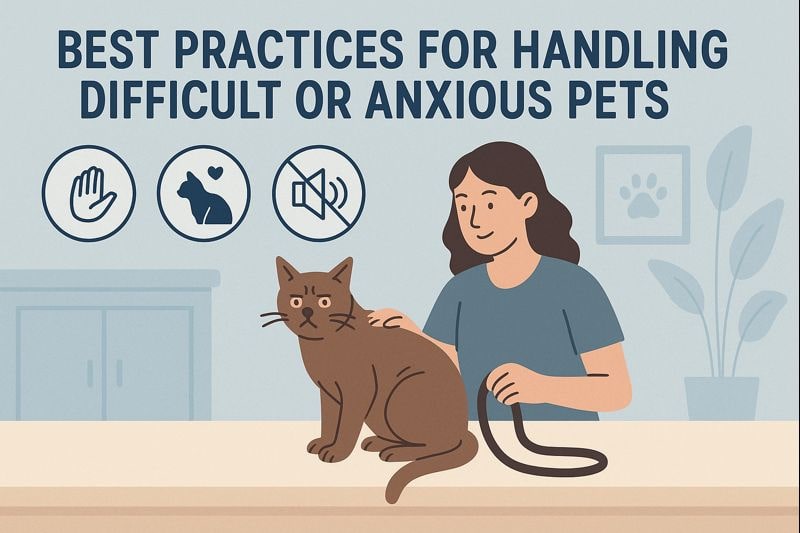
Best Practices for Handling Difficult or Anxious Pets
Handling difficult or anxious pets is equal parts compassion, planning, and safety. Many “difficult” pets aren’t trying to be stubborn or “dominant”—they’re scared, overwhelmed, in pain, under-socialized, or reacting to past experiences.
When you treat fear and stress as real, measurable welfare issues (not “bad behavior”), handling difficult or anxious pets becomes more predictable and humane.
Veterinary organizations and behavior leaders consistently emphasize low-stress, least-restraint approaches because forceful handling can increase injury risk and worsen future fear responses.
This guide is designed for everyday life: home care, visitors, walks, grooming, transport, and vet visits. You’ll learn how to read early warning signs, set up environments that prevent panic, and build cooperative skills so handling difficult or anxious pets doesn’t feel like a wrestling match.
You’ll also see where medication, professional help, and management tools fit in—and how to use them ethically. (Because the safest plan is always the plan that prevents your pet from needing to “prove” they’re scared.)
If you take one principle from this article, make it this: handling difficult or anxious pets works best when you reduce triggers first, then train cooperation slowly, and only then attempt more challenging handling.
That order—environment → skills → procedures—keeps everyone safer and helps your pet actually feel better, not just “held still.”
Why pets become difficult or anxious during handling
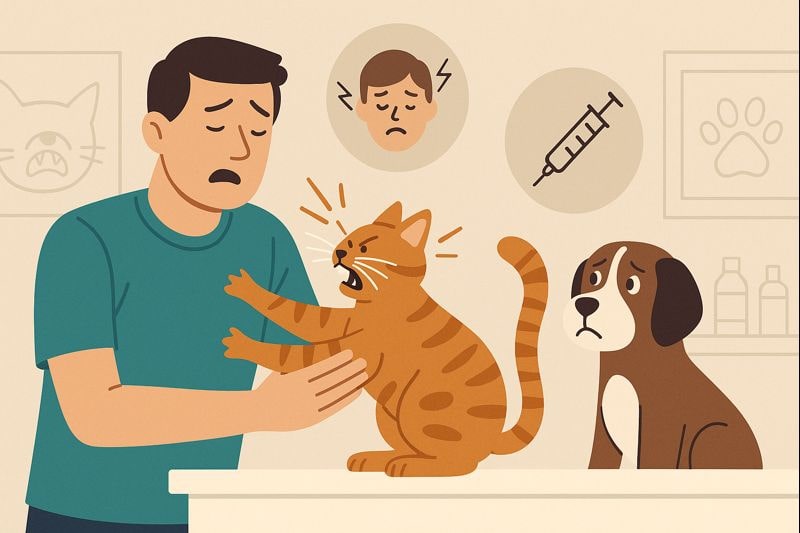
Handling difficult or anxious pets usually starts with biology and learning, not attitude. A pet can appear “fine” in calm settings but panic during handling because restraint removes their ability to escape.
That loss of control can flip the nervous system into fight/flight/freeze, especially if the pet is already stressed from noise, unfamiliar people, other animals, slippery floors, or painful body parts.
Low-stress handling education for veterinary teams notes that a large portion of pets show fearful behaviors in clinical settings, and that lowering stress reduces harm and improves outcomes.
Past experiences matter too. One frightening nail trim, forced bath, or rough exam can condition fear that intensifies the next time. Over time, the pet learns: “Handling predicts scary things,” so they escalate faster.
That escalation can look like growling, snapping, hiding, stiffening, or thrashing—behaviors that are communication and self-protection, not “spite.”
Pain is a major hidden driver. Arthritis, ear infections, dental pain, skin irritation, and GI discomfort can make even gentle touch feel threatening. If your normally sweet pet suddenly resists handling, assume discomfort first and consider a vet check.
AAHA’s behavior management guidance emphasizes integrating behavioral management into clinical care and recognizing normal vs. abnormal behavior across life stages.
Finally, genetics and early socialization shape resilience. Some pets are naturally more sensitive; others missed key early exposure to touch, surfaces, grooming tools, or strangers.
The good news: handling difficult or anxious pets can improve dramatically with cooperative care training, predictability, and the right environment—even when the pet is naturally cautious.
Safety first: how to prevent bites, scratches, and panic spirals
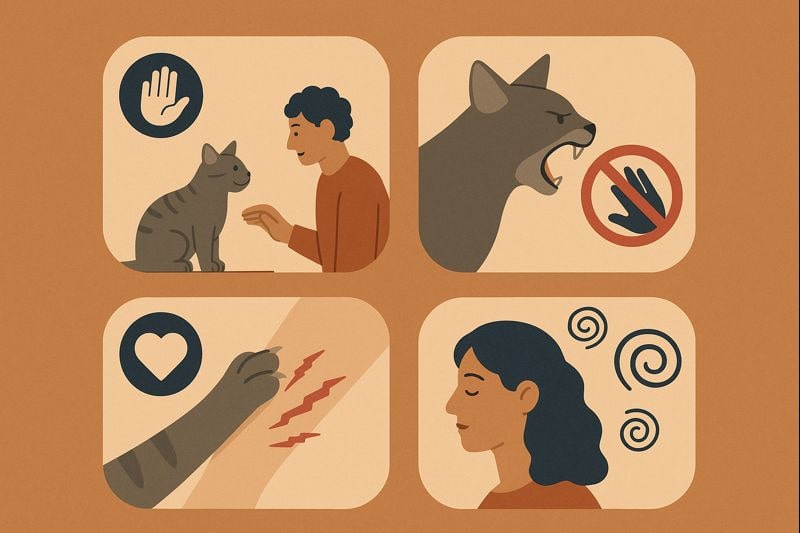
Handling difficult or anxious pets safely starts with prevention—not bravery. Most injuries happen when people push past early warning signs. The goal is to keep the pet under threshold: aware of the situation, but still able to eat treats, respond to cues, and recover quickly.
When a pet is over threshold, learning shuts down and survival behaviors take over. At that point, “just get it done” often creates a bigger problem later.
A core best practice for handling difficult or anxious pets is least restraint necessary. AAHA specifically warns that manual restraint and forceful handling increase risk of injury and can harm medical and emotional outcomes, and it gives examples of inappropriate restraint. The safest choice is often to pause, reduce intensity, change the setup, or reschedule with a better plan.
Also, understand trigger stacking. Your pet may handle one stressor, but multiple stressors (doorbell + visitor + slippery floor + reaching hands) can stack until they explode. For handling difficult or anxious pets, you’ll do better by reducing the whole day’s stress: calm walk times, quiet rooms, decompression, and fewer surprises.
Practical safety habits:
- Keep your face away from your pet’s face during stressful moments.
- Use barriers: baby gates, crates, pens, closed doors.
- Prevent cornering: always give an exit route.
- For cats: use towel wraps and carriers that open from the top or separate into halves when possible.
- For dogs: consider gradual basket muzzle training (never as a punishment). Behavior resources for anxious patients include basket muzzles as a bite-prevention tool when properly fitted and introduced.
If you feel unsafe, stop. Handling difficult or anxious pets should never require you to “power through” fear signals. Safety is a skill, not a test of courage.
Reading body language: your early-warning system
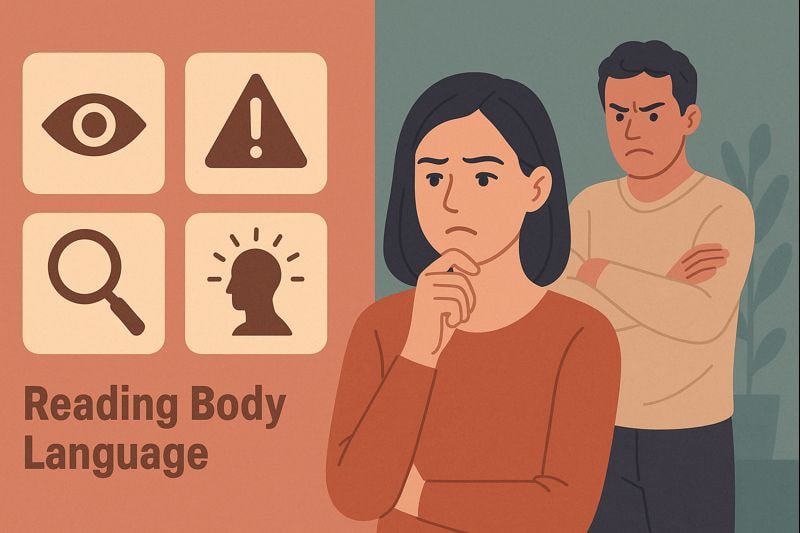
Handling difficult or anxious pets gets much easier when you learn the “quiet” signs that come before growling or snapping. Many pets communicate discomfort subtly—then get labeled “unpredictable” when people miss the earlier signals. Your job is to catch the whispers so the pet never needs to shout.
Micro-signs of stress in dogs and what they mean
When handling difficult or anxious pets, start by looking for soft, early stress signals: lip licking, yawning when not tired, turning the head away, “whale eye” (showing the whites), paw lift, sudden sniffing, slow-motion movement, or freezing.
These often mean “I’m not comfortable; please slow down.” As stress rises you may see stiff posture, weight shifted back, closed mouth, pinned ears, hard staring, growling, or snapping. Those are not “bad manners”—they’re warnings. Respecting them protects everyone.
A useful habit is to rate your dog’s stress on a simple scale (1–5) before you touch them:
- relaxed, 2) mildly unsure, 3) tense but coping, 4) close to reacting, 5) reacting.
If your dog is at 4–5, handling difficult or anxious pets becomes a safety problem, not a training opportunity. That’s when you switch to management: distance, barriers, and calming routines.
Support your dog with predictability:
- Tell them what happens next (a cue like “chin” or “paw”).
- Use steady, slow movement (fast hands can spike fear).
- Touch the “easy zones” first (shoulders/chest) before sensitive areas.
- Keep sessions short and end in success.
Fear Free and low-stress handling programs emphasize early recognition of fear/anxiety/stress and intervening before escalation, because that prevents negative associations from forming. In real life, that means: if you see the small signs, you adjust immediately—so handling difficult or anxious pets never reaches the danger zone.
Micro-signs of stress in cats and what they mean
Cats often get mislabeled as “spicy” when they’re simply terrified. Handling difficult or anxious pets in feline form requires extra respect for space and control.
Early stress signals include crouching, flattened ears, tail tucked or whipping, dilated pupils, skin twitching, hiding, low growls, and rapid grooming. Some cats go still and silent before they strike—freeze is not consent.
Low-stress handling education notes common fearful cat postures (crouching, lowered head, ears lowered/flattened) and links veterinary stress to measurable physiologic changes (like elevated heart rate and temperature). This matters because a frightened cat isn’t just “moody”; their body is in alarm mode.
For handling difficult or anxious pets that are cats:
- Offer choice: open carrier, multiple perches, hidey boxes.
- Approach from the side, not from above.
- Use towels as “privacy + traction,” not as force.
- Keep handling brief; stop before the cat feels trapped.
- Avoid scruffing for routine care—major organizations recommend humane, least-stress approaches.
If you can read your cat’s “no thank you” signals early, you’ll prevent the full panic response—and handling difficult or anxious pets becomes calmer, faster, and safer.
Set up a low-stress home environment that makes handling easier
Handling difficult or anxious pets is dramatically easier when your environment does half the work. Think of your home as a “behavior support system.”
If your floors are slippery, your lights are harsh, your routine is unpredictable, and your pet is constantly startled, even gentle handling can feel threatening. Small changes can reduce overall stress and make cooperation possible.
Start with traction and stability. Place rugs or yoga mats in grooming areas and near doors. Slipping increases panic and can make pets associate handling with loss of control. Next, reduce noise triggers: white noise machines, soft music, closed windows during loud times, and quiet “safe zones” away from foot traffic.
Create a predictable routine. Many difficult or anxious pets cope better when they can predict meals, walks, rest, and training. Add a short “calm cue” routine (snuffle mat, lick mat, scatter feeding) before any handling session. Licking and sniffing are naturally regulating behaviors, and they help many pets stay under threshold.
Also, design escape routes. Cornered pets defend themselves. Use baby gates, pens, and open doorways so the pet never feels trapped. For cats, vertical space is calming—cat trees and shelves allow distance and control. For dogs, a crate or quiet room can be a decompression zone (only if introduced positively).
If your pet fears visitors, don’t wait until the doorbell rings to practice. Handling difficult or anxious pets improves when you manage the whole day:
- Leash the dog before guests arrive.
- Put the cat in a safe room with litter, water, and enrichment.
- Use visual barriers (frosted film, curtains) if outside motion triggers barking.
Many Fear Free and low-stress resources highlight environmental adjustments—like reducing loud noises, using non-slip flooring, and creating calmer spaces—because environment is a powerful lever for stress reduction.
When the environment supports calm, handling difficult or anxious pets stops being a battle and becomes a skill-building moment.
Cooperative care training: the gold standard for handling difficult or anxious pets
Cooperative care means your pet learns to participate in handling voluntarily. Instead of “hold still,” you teach your pet to offer a paw, rest their chin, step onto a mat, or accept a brief touch—then you stop before they panic.
Cooperative care doesn’t mean your pet controls everything; it means you build a system where handling difficult or anxious pets is predictable, rewarded, and safe.
Teaching consent signals and “start button” behaviors
A consent signal is a behavior that tells you your pet is ready. A “start button” is how the pet opts in. For dogs, common start buttons include chin rest in your hand, standing on a platform, or placing their head through a loose loop (like a towel loop for future collar handling).
For cats, a start button can be stepping onto a towel, touching a target stick, or staying relaxed on a mat.
The key to handling difficult or anxious pets is honoring the opt-out. If the pet lifts their chin, steps away, or leaves the towel, you pause. That teaches them: “I don’t need to fight to make this stop.” Over time, most pets opt in longer because they feel safe.
How to train it:
- Choose a calm space and ultra-high-value rewards (tiny pieces).
- Mark and reward the start button behavior.
- Add tiny handling steps: one-second touch, then treat.
- End early, every time. Short wins build confidence.
This approach aligns with low-stress handling principles that aim to prevent escalation and create positive associations with procedures. When you build consent into your routine, handling difficult or anxious pets becomes cooperative rather than confrontational.
Desensitization and counterconditioning done correctly
These two terms are everywhere, but the details matter. Desensitization means exposing your pet to a trigger at a low intensity they can handle.
Counterconditioning means pairing that trigger with something good until the emotional response shifts. For handling difficult or anxious pets, the trigger might be nail clippers, a brush, ear drops, being lifted, or the sound of a carrier latch.
The biggest mistake is going too fast. If your pet stops eating, stiffens, or tries to escape, you’re over threshold and the session is teaching fear. Instead:
- Start with the tool far away (clippers on the table).
- Feed treats for calm.
- Move the tool slightly closer only when the pet is relaxed.
- Touch the body area without using the tool.
- Mimic the action (tap nail with clipper closed).
- Clip one nail, then throw a “treat party” and stop.
For cats, you might start by simply rewarding the cat for entering a carrier or standing on a towel. For dogs, reward for placing paws on a mat while you handle the brush.
A major review on mitigating fear and aggression in veterinary settings emphasizes avoiding negative experiences and promoting positive emotions through thoughtful handling and conditioning. At home, you’re doing the same thing: changing the emotional meaning of handling. That’s the heart of handling difficult or anxious pets long-term.
Grooming and hygiene: nail trims, baths, brushing, ears, and meds without a fight
Grooming is one of the most common reasons people struggle with handling difficult or anxious pets. The good news: grooming is also one of the best places to use cooperative care, because you can practice tiny steps daily without pressure.
Nail trims for difficult or anxious pets
For nail trims, your goal is not “all nails today.” Your goal is “calm practice that builds trust.” Start by pairing paw touch with treats. Then progress to holding the paw gently for one second, treat, release.
Add the clipper sound separately (click, treat). Handling difficult or anxious pets improves when you split the experience into ingredients your pet can tolerate.
Practical tips:
- Trim after exercise when your dog is calmer.
- Use a non-slip mat and good lighting.
- Consider a nail file or grinder if your pet tolerates vibration better (still introduced slowly).
- Do one nail per session if needed.
- Stop immediately if you see stiffening or pulling away—honor the opt-out.
If your pet has a bite history, muzzle training is a smart layer of safety. Basket muzzles are commonly recommended in anxious-patient handling resources because they prevent bites while allowing panting and treats when properly fitted and trained.
Baths, brushing, and mat removal without panic
For baths, reduce sensory overload:
- Prepare everything before bringing your pet in.
- Use lukewarm water and low pressure.
- Place a towel on the tub floor for traction.
- Keep sessions short.
- Reward calm moments with lick mats (if safe for your pet).
For brushing and mat removal, avoid pain. Mats tug skin, and forced detangling can create lasting fear. Use a cooperative station (mat or platform), reward short brush strokes, and stop often. If mats are severe, a professional groomer or vet may need to help—sometimes sedation is kinder than force.
For ears, teeth, and meds:
- Start with “touch near the area,” then treat.
- Progress to “lift ear flap,” treat.
- Progress to “touch tooth with finger,” treat.
- Only then add actual drops or brushing.
Handling difficult or anxious pets with grooming succeeds when you prioritize comfort over completion. The “all-or-nothing” mindset is what turns grooming into trauma. With skill-building, your pet learns grooming is predictable and safe.
Vet visits and medical handling: making exams safer and less stressful
For many families, the hardest part of handling difficult or anxious pets is medical care: carriers, car rides, exams, blood draws, vaccines, and procedures. Veterinary leaders increasingly promote Fear Free and low-stress handling methods because restraint-heavy visits can worsen fear and reduce care quality.
Preparing at home: carrier, car, and “mock exams”
Start days or weeks before the visit:
- Keep the carrier out all the time (not a “bad news box”).
- Feed meals near it, then inside it.
- Practice closing the door for one second, treat, reopen.
- For dogs, practice standing on a mat while you touch ears, paws, belly, and tail gently.
Do “happy car reps”: sit in the car, treat, leave. Then short rides to nowhere, fun, treats, and home. The point is to break the pattern that car = vet = scary. Handling difficult or anxious pets improves when you train the whole chain, not just the exam.
At the clinic: advocate for low-stress handling
Ask for practical supports:
- Wait in the car instead of the lobby.
- Request a quiet room.
- Use treats during the exam (if medically appropriate).
- Ask the team to go slowly and use minimal restraint.
AAHA’s humane restraint guidance explicitly encourages least stressful, most humane handling and warns that forceful restraint can be detrimental and increase injury risk. Many clinics now use low-stress handling protocols and Fear Free principles, focusing on early intervention and positive associations.
Also consider “split visits”: one appointment for treats + weight + brief exam, another for vaccines. This can be life-changing for handling difficult or anxious pets, because it prevents your pet from associating every visit with intense procedures.
Medication and sedation: when it’s kinder than force
Some pets need pharmaceutical support to stay safe and avoid trauma. This is not a moral failure—it’s humane medicine. Clinical resources on managing fear and anxiety in veterinary patients discuss recognizing stress and using antianxiety medications when appropriate as part of a broader low-stress strategy.
What this can look like (always under veterinary guidance):
- Pre-visit anxiolytics to reduce panic.
- Topical numbing or pain control for sensitive procedures.
- Sedation for cats or dogs who would otherwise experience terror and risk injury.
For handling difficult or anxious pets, “chemical restraint” is sometimes safer and more compassionate than physical struggle, especially when your pet’s fear is severe or when procedures are painful. The best outcome is a pet who leaves the clinic with fewer negative memories, not just a procedure that “got done.”
Tools and techniques that reduce stress without relying on force
Handling difficult or anxious pets becomes much safer when you build a toolkit. The right tool, introduced correctly, can prevent injuries and keep the pet’s fear from escalating.
Basket muzzles, harnesses, and leashes: safety layers that protect trust
A well-fitted basket muzzle can be a humane safety tool when conditioned positively. The muzzle should allow panting and treat delivery; it should never be used to “shut the dog up” or as punishment. Handling-anxious-patient resources include basket muzzles among recommended tools to prevent bites.
Front-clip harnesses can reduce pulling and give you better control without choking. Double-clip systems (front + back) add safety for reactive dogs. For cats, secure carriers and soft towels can reduce panic during transport and exams.
Key point: tools don’t replace training, but they buy you time. They help handling difficult or anxious pets stay safe while you teach cooperative skills.
Enrichment as regulation: sniffing, licking, chewing, and choice
Enrichment isn’t a luxury for anxious pets—it’s nervous system support. Before handling:
- Scatter treats to encourage sniffing (sniffing is calming).
- Use lick mats (if safe) to promote soothing repetitive licking.
- Offer chew items for dogs who settle with chewing.
Choice matters. Offer two options when you can: “mat here or mat there,” “carrier left or right,” “touch paw now or later.” Choice reduces helplessness, and reduced helplessness makes handling difficult or anxious pets easier.
Low-stress handling approaches emphasize reducing fear and protective emotions to improve welfare and safety. At home, enrichment and choice are simple ways to lower baseline stress so your pet has more capacity to handle gentle touch.
When to involve a professional: trainers, behavior consultants, and veterinary behaviorists
Sometimes, handling difficult or anxious pets requires more than DIY training—especially if there’s biting, severe panic, or escalating aggression. Getting help sooner can prevent months or years of worsening fear patterns.
A qualified professional can:
- Identify triggers you might be missing.
- Create a structured behavior plan with measurable steps.
- Teach you safe handling mechanics and management.
- Coordinate with your vet on pain control and medication support.
Look for credentials and ethical standards. Organizations like the International Association of Animal Behavior Consultants publish standards of practice and ethics for behavior consulting, emphasizing professional best practices and updated guidance.
If your pet’s behavior is dangerous or complex, a board-certified veterinary behaviorist (a veterinarian with specialized behavior training) can integrate medical and behavior treatment.
If you’re working with a trainer for handling difficult or anxious pets, prioritize force-free, reward-based methods. Punishment-based techniques can suppress warning signals without reducing fear—making bites more likely because the pet stops “warning” and jumps straight to action. A good behavior plan builds emotional safety first.
Signs you should seek professional support:
- Your pet has bitten or attempted to bite.
- Your pet panics during handling (thrashing, urinating/defecating, intense escape attempts).
- You can’t complete essential care (meds, nail trims, vet exams).
- Behavior is worsening over time or spreading to more contexts.
Handling difficult or anxious pets is a solvable problem for many families—but when risk is high, support is part of responsible care, not an extra.
Special scenarios: kids, guests, multi-pet homes, and emergencies
Handling difficult or anxious pets gets more complicated when real life happens—kids run, guests arrive, another pet stares, or you need urgent care. Planning for these situations keeps everyone safe.
In homes with children, management is non-negotiable. Teach kids:
- No hugging or face-to-face contact.
- No reaching into beds/crates/carriers.
- No chasing or cornering.
- “Hands off when the pet walks away.”
Use gates and closed doors during high-energy times. For guests, pre-plan: leash the dog before opening the door, or place them in a calm room with enrichment. For cats, safe-room setups prevent panic. Handling difficult or anxious pets around visitors is mostly about preventing rehearsals of fear-based behavior.
In multi-pet homes, reduce conflict during handling:
- Separate pets during feeding and high-value items.
- Avoid handling one pet while another crowds the space.
- Watch for resource guarding and tension.
Emergencies require a “grab-and-go” plan:
- Keep a slip lead, towel, and carrier accessible.
- Condition the carrier and muzzle in advance (before you need them).
- Have your pet’s medical records and medications organized.
Low-stress handling resources emphasize that fear can escalate quickly and that preventing escalation improves safety for humans and animals.
In urgent moments, your goal is containment with minimal trauma. If you can’t handle your pet safely, seek professional help immediately—emergency clinics and animal control often have tools and training for safe transport.
Future trends and predictions for handling difficult or anxious pets
Handling difficult or anxious pets is evolving fast, driven by better welfare science, changing client expectations, and the growth of Fear Free and low-stress handling education.
Fear Free programs have expanded widely across pet professionals and are increasingly integrated into training and practice culture. Looking ahead, several trends are likely to shape the “latest and updated” best practices.
First, expect more clinics to redesign patient flow: separate waiting areas, curbside check-in options when needed, quieter exam rooms, and more staff training in fear/anxiety/stress (FAS) recognition.
Low-stress handling content continues to emphasize environmental and procedural adjustments because they improve safety and clinical efficiency.
Second, cooperative care will become more mainstream for everyday owners. As more trainers teach consent-based handling, families will increasingly practice “mock exams,” carrier games, muzzle conditioning, and grooming desensitization as standard puppy/kitten education. That means the baseline for handling difficult or anxious pets may improve over time as prevention becomes normal.
Third, expect more individualized medication strategies—especially pre-visit plans that prevent trauma. Clinical discussions already emphasize that anxiety management can include medication as part of a broader low-stress approach.
The future likely includes more tailored protocols, better client education, and more acceptance that “less struggle” is better medicine.
Finally, professional standards and continuing education in behavior will keep advancing. Industry organizations continue updating practice standards and educational offerings, which helps reduce outdated, force-based advice.
The direction is clear: handling difficult or anxious pets is moving toward humane, consent-aware, science-based care—because it works.
FAQs
Q.1: How do I know if my pet is anxious or just “being stubborn”?
Answer: Handling difficult or anxious pets becomes clearer when you watch body language and context. If the behavior happens mainly during restraint, grooming, vet visits, or specific touch areas, anxiety or pain is more likely than stubbornness.
Look for stress signals (freezing, turning away, tense muscles, dilated pupils, tucked tail, flattened ears). If the behavior is sudden or new, rule out pain with a veterinary exam.
Q.2: Is it okay to “just hold them tighter” so the task gets done?
Answer: For handling difficult or anxious pets, tighter restraint often backfires. AAHA warns that forceful handling can increase injury risk and harm emotional outcomes, and encourages least-stress, humane methods.
In many cases, pausing, changing technique, splitting the task into smaller steps, or using medication support is safer and kinder than escalating restraint.
Q.3: Should I use a muzzle, and will it make my dog more aggressive?
Answer: A muzzle doesn’t cause aggression—fear and learned associations do. A properly fitted basket muzzle, introduced with positive training, is a safety tool that can reduce risk while you work on behavior.
Some anxious-patient handling guidance includes basket muzzles as a bite-prevention measure.The key is conditioning: your dog should happily place their nose in the muzzle because it predicts good things.
Q.4: What’s the fastest way to improve handling difficult or anxious pets?
Answer: The fastest safe improvement usually comes from: (1) reducing triggers, (2) practicing cooperative care daily for 1–3 minutes, and (3) getting pain/anxiety support from your vet when needed.
Low-stress handling approaches emphasize early intervention to prevent escalation and negative associations. Fast progress is possible, but rushing the steps can create setbacks.
Q.5: When is medication appropriate for anxious handling?
Answer: Medication can be appropriate when fear is severe, when there’s a bite risk, or when essential care can’t be completed without distress.
Clinical resources on veterinary patients discuss using antianxiety medications as part of a broader plan to manage fear and improve safety. For handling difficult or anxious pets, medication is often a bridge that makes training possible—not a replacement for training.
Q.6: My cat turns into a different animal at the vet—what can I do?
Answer: Focus on the whole chain: carrier comfort, transport, waiting, and exam handling. Practice carrier games at home, use familiar bedding, and ask the clinic about low-stress handling options.
Many low-stress protocols emphasize minimizing fear and using gentle handling and environmental control. For some cats, pre-visit medication is the kindest choice.
Conclusion
Handling difficult or anxious pets isn’t about “winning” control—it’s about building safety and trust so your pet no longer feels the need to defend themselves.
The most reliable path is consistent: reduce triggers, read early body language, use least-restraint techniques, and train cooperative care with tiny steps. Major veterinary and behavior organizations emphasize low-stress, humane handling because it improves welfare and reduces injury risk for everyone involved.
If you’re struggling, you’re not alone—and your pet isn’t “bad.” With a better setup, clearer communication, and (when needed) professional and medical support, handling difficult or anxious pets can become calmer, safer, and even routine.
The future of pet care is moving toward consent-aware, fear-reducing approaches because they work in the real world: fewer injuries, better health care access, and a pet who feels secure in your hands.