
Cloud-Based Systems for Veterinary Practices
Cloud-based systems for veterinary practices have quietly become the operating system of modern animal care. They bring scheduling, medical records, imaging links, payments, inventory, communications, reporting, and telehealth into one connected workflow—without tying your clinic to a single server closet or a single workstation.
What makes cloud-based systems for veterinary practices different isn’t just “software in a browser.” It’s the ability to standardize how the team works, reduce double entry, and keep information available where care happens: in exam rooms, treatment, reception, remote consults, and even on-call situations.
Practices that switch usually do it for speed, reliability, and visibility—fewer missing charges, fewer missed reminders, faster checkouts, better follow-up, and cleaner reporting.
At the same time, cloud-based systems for veterinary practices raise important questions: data security, downtime planning, integration quality, staff training, and how telehealth fits into a patchwork of rules. The strongest clinics treat the move to cloud like a clinical change management project, not a “new app.”
This guide walks through what to buy, how to implement it, how to keep it secure, and how to future-proof your stack—with practical decisions you can use immediately.
What “Cloud-Based” Really Means in a Veterinary Clinic
Cloud-based systems for veterinary practices typically run on vendor-managed infrastructure and are accessed through a web browser or lightweight app.
The key difference is responsibility: you’re no longer maintaining the server, backups, patches, and remote access plumbing in-house. The vendor operates the environment, while your clinic configures workflows, permissions, templates, and integrations.
In a clinical setting, “cloud-based” matters most in three moments: high-traffic check-in/check-out, documentation at the point of care, and after-hours continuity.
If a patient comes in for an urgent issue, cloud-based systems for veterinary practices let the team pull history, allergies, vaccines, lab results, prior imaging links, and estimates quickly—without hunting for paper notes or waiting for one computer.
Cloud models also tend to improve standardization. You can roll out consistent SOAP templates, medication instructions, discharge summaries, preventive care bundles, and client education across every provider. That consistency drives better client understanding and reduces the risk of missed steps.
Finally, cloud-based systems for veterinary practices usually evolve faster than older on-premise systems because updates can be delivered continuously. That can be a major advantage when new automation tools arrive—like AI documentation support in veterinary settings, which is being adopted by leading institutions.
Core Benefits of Cloud-Based Systems for Veterinary Practices
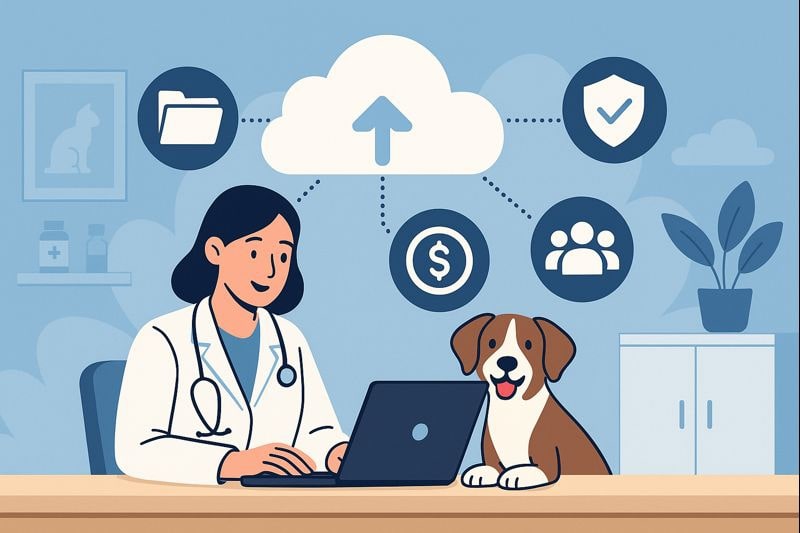
Cloud-based systems for veterinary practices are popular because they reduce friction in the daily “care-to-cash” process. Most clinics don’t feel the pain of slow systems until they see how much time is being lost: repeated questions at reception, missing charges, unclear inventory counts, missed reminders, and incomplete records.
One high-impact benefit is workflow visibility. When a cloud platform is configured well, everyone can see patient status, task queues, and pending items: labs to review, refills awaiting approval, callbacks due, preventive care gaps, and estimates awaiting signature. That visibility reduces bottlenecks and creates accountability without adding meetings.
Another major benefit is better client communication. Cloud-based systems for veterinary practices commonly support automated reminders, two-way texting, appointment confirmations, follow-up check-ins, and digital forms. When those tools are tied to the medical record and the schedule, teams spend less time chasing details and more time delivering care.
Cloud adoption also supports multi-location growth. If you operate more than one clinic, cloud-based systems for veterinary practices can unify coding standards, inventory rules, provider templates, pricing, and reporting. That makes staff float coverage and cross-location record access far easier, while still maintaining role-based access controls.
And from a business perspective, market research shows continuing growth and investment in veterinary software—driven by cloud delivery, AI, and telehealth.
Key Modules to Prioritize in Cloud-Based Systems for Veterinary Practices
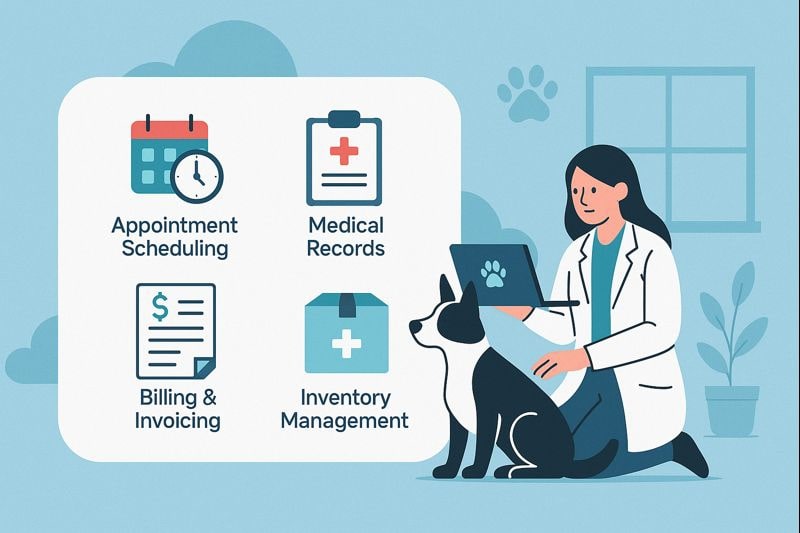
Cloud-based systems for veterinary practices can mean many things, from simple scheduling tools to full practice management platforms. To avoid buying the wrong “cloud,” focus on modules that directly impact throughput, compliance, and revenue integrity.
Practice Management and Electronic Medical Records
The foundation is a practice management system with a strong EMR. Cloud-based systems for veterinary practices should allow fast charting, configurable SOAP templates, problem lists, vaccine tracking, medication management, and easy attachment or linking of labs and imaging. Speed matters: if charting is clunky, staff create workarounds that weaken the record.
Look for flexible templates that support your clinic’s style—wellness, urgent care, dentistry, surgery, exotics, or mixed workflows.
Make sure the system handles weight-based dosing checks, repeatable order sets, and clear audit trails for changes. In day-to-day terms, you want fewer “where did that note go?” moments and fewer missed charges because the item wasn’t tied to the treatment plan.
Also confirm permissions. Cloud-based systems for veterinary practices should let you define what assistants, technicians, CSRs, managers, and veterinarians can do—especially around controlled workflows like refunds, discounting, record deletion, and prescription approval.
Scheduling, Capacity Planning, and Digital Intake
Scheduling isn’t just a calendar. In cloud-based systems for veterinary practices, scheduling should manage capacity: appointment types, provider availability, room usage, technician appointments, and drop-off logic. If your system can’t model how your clinic actually runs, your schedule becomes chaotic.
Digital intake is a force multiplier. The best setups combine confirmation texts, online forms, symptom questionnaires, and photo uploads before arrival. That reduces lobby time, improves exam readiness, and creates cleaner histories. When intake is connected to the record, it also reduces retyping and errors.
Capacity planning is where cloud-based systems for veterinary practices shine. You can measure average appointment duration by type, identify bottlenecks, and redesign templates. That’s how practices add appointments without burning out staff—by designing the day rather than “surviving” it.
Billing, Payments, and Revenue Integrity
Charging correctly is one of the easiest ways to lift profit without increasing volume. Cloud-based systems for veterinary practices should support bundles, treatment plans, estimates, deposits, payment links, and integrated card processing.
The big win is preventing leakage: meds dispensed but not charged, labs run but not invoiced, or discounts applied inconsistently.
Look for tools that create a clear path from clinical actions to invoices. For example: when a technician logs a vaccine administration, the charge should appear automatically unless intentionally suppressed. When a provider signs a dental procedure note, the related fee schedule items should already be in the cart.
Also prioritize reporting clarity. You want to see average transaction value, discount rates, charge capture, outstanding estimates, unpaid invoices, and provider production without exporting ten different files. Cloud-based systems for veterinary practices can do this well—if the platform’s data model is designed for it.
Inventory, Purchasing, and Controlled Access
Inventory is often the most underestimated profit lever. Cloud-based systems for veterinary practices should track on-hand counts, reorder points, expiry, lot numbers when relevant, and purchase orders. The goal is to reduce stockouts and reduce dead stock.
Inventory is also a compliance and security issue. Restrict who can adjust counts and who can receive items. Use logs to identify shrink patterns. Market research across industries continues to highlight growth in cloud inventory systems and real-time tracking demand, which aligns with what clinics need operationally.
A practical test: ask how the system handles partial vials, compounding, and common “clinic reality” scenarios. If it only works in a perfect-world retail model, your team will stop using it and inventory accuracy will collapse.
Data Security and Risk Management for Cloud-Based Systems for Veterinary Practices
Security isn’t optional. Cloud-based systems for veterinary practices concentrate sensitive client information, payment activity, medical history, and internal operations. While vendors manage infrastructure, clinics still control many of the highest-risk points: passwords, device hygiene, staff permissions, and phishing awareness.
A strong clinic security posture starts with identity and access. Enforce unique user accounts, role-based permissions, strong passwords, and multi-factor authentication whenever available. Limit administrative access to people who truly need it, and review access when staff roles change. This is how you reduce the blast radius of one compromised login.
Next is endpoint and network hygiene. Your cloud platform may be secure, but a malware-infected front desk computer can still expose credentials. Veterinary-focused cybersecurity guidance emphasizes the reality of attacks against clinics and the need for layered protections.
Backups and downtime planning still matter in the cloud era. Ask your vendor about business continuity, disaster recovery, and how quickly service is restored in an incident. Separately, build a clinic-level downtime workflow: how you capture charges, how you document care temporarily, how you verify medication history, and how you reconcile later.
Finally, watch emerging risks tied to AI features that plug into cloud-based systems for veterinary practices. AI documentation, summarization, and communication tools can be powerful, but they also introduce new data handling considerations. Vendor guidance in this area increasingly focuses on managing data risk as AI adoption grows.
Telehealth, Remote Care, and Compliance in Cloud-Based Systems for Veterinary Practices
Telehealth is now a standard expectation for many clients, but veterinary telemedicine is shaped by relationship rules and prescribing constraints.
Cloud-based systems for veterinary practices can support telehealth workflows—online triage forms, video consult links, documentation templates, and follow-up automations—yet your clinic must align workflows with applicable rules.
A practical starting point is understanding the veterinarian-client-patient relationship concept and how it affects prescribing and medical direction. Federal guidance explains when a VCPR is required for certain prescribing and dispensing contexts, and it notes that states may have additional requirements.
States vary widely in how they define telehealth, teletriage, and telemedicine, and what is required to establish a relationship remotely. Professional resources describe this “patchwork” and provide state examples, including restrictions such as in-person exam requirements and limits on prescribing controlled substances via telemedicine.
From a systems perspective, cloud-based systems for veterinary practices should support compliant telehealth documentation: capturing consent, recording the modality used, documenting clinical reasoning, and clearly specifying follow-up needs. The best platforms also link telehealth notes to reminders and recheck schedules automatically.
Future direction: telehealth will likely continue expanding as access challenges persist, but with ongoing guardrails around controlled substances and relationship requirements. Legislative activity in multiple areas keeps this topic dynamic, so your clinic should build telehealth workflows that can be tightened quickly if needed.
Integrations That Matter in Cloud-Based Systems for Veterinary Practices
Cloud-based systems for veterinary practices rarely operate alone. Real efficiency comes from integrations that remove double entry and keep data consistent. The key is choosing “deep” integrations, not superficial ones that only pass a PDF.
Laboratory and Diagnostic Integrations
Your system should integrate with reference labs and in-house analyzers in a way that posts results to the correct patient record, flags abnormal values, and supports trend viewing over time. When lab integration is weak, teams waste time scanning, uploading, and interpreting results without context.
The best cloud-based systems for veterinary practices link lab orders to charges and to follow-up tasks. For example: ordering a senior panel triggers both billing items and a reminder task for the provider to review within a set timeframe. That turns lab work into a closed-loop clinical process.
Imaging, Dental Charting, and Specialty Tools
Many clinics rely on imaging viewers, dental charting, and specialty calculators. Cloud-based systems for veterinary practices should either include these capabilities or integrate smoothly without breaking workflow. Even if the imaging system is separate, the record should show a clean link, not a scavenger hunt.
Ask how the platform handles attachments: size limits, formats, and whether files are searchable. The operational goal is simple—any clinician should be able to open the relevant diagnostic information in seconds, during the appointment, without asking three people.
Communications, Reminders, and Client Experience Layers
Client experience is increasingly software-driven. Two-way text, email reminders, payment links, online scheduling, and review prompts all sit on top of cloud-based systems for veterinary practices. The risk is fragmentation: five different tools that don’t share data and create contradictions.
Choose communication tools that read the appointment schedule, respect client preferences, and log messages back to the record. Your team should never wonder, “Did we already text them?” A unified communication trail reduces disputes and improves continuity.
Implementation and Change Management for Cloud-Based Systems for Veterinary Practices
A successful launch is less about the software and more about how you implement it. Cloud-based systems for veterinary practices touch every role, so implementation must be staged, measured, and supported.
Start with workflow mapping. Document how appointments are booked, how estimates are created, how meds are dispensed, how labs are ordered, how rechecks are scheduled, and how payments are collected.
Then redesign workflows around the system’s strengths. If you simply recreate old habits in a new interface, you won’t get the gains cloud systems can deliver.
Data migration is the next major risk point. Decide what comes over: active clients, patient history, vaccine records, balances, and attachments. Confirm what is converted into structured data versus imported as static files.
Cloud-based systems for veterinary practices perform best when data is structured—so reminders, reporting, and decision support can work.
Training must be role-based. CSRs need scheduling, intake, payments, and communication. Technicians need treatment plans, inventory use, lab orders, and task management. Veterinarians need templates, charting shortcuts, prescribing, and follow-ups. Give each role a clear definition of “done right” and provide checklists.
Finally, measure success. In the first 30–90 days, track charge capture, appointment throughput, callback completion, and record completeness. Modern practice management guidance increasingly highlights AI automation and data-driven decision-making as part of how clinics operate in 2025 and beyond.
Cloud-based systems for veterinary practices make those measurements easier—if you commit to using the reports and acting on them.
Cost, ROI, and Vendor Selection for Cloud-Based Systems for Veterinary Practices
Pricing models vary. Cloud-based systems for veterinary practices may charge per provider, per location, per user tier, or by feature bundles. The number that matters is not the subscription—it’s the total cost of ownership and the total operational lift.
ROI comes from four areas: time saved, revenue captured, retention improved, and risk reduced. Time saved shows up in faster checkouts, fewer phone calls, and fewer manual reminders.
Revenue captured shows up in fewer missed charges and more consistent estimates. Retention improves when clients get timely reminders and clear follow-ups. Risk reduction includes fewer security incidents and fewer compliance mistakes around documentation and telehealth.
When evaluating vendors, ask for proof in your exact workflow: wellness, urgent, surgery, dentistry, boarding, grooming, mobile, or mixed. Run scenario demos: “Walk me from scheduling to checkout for a vomiting dog with diagnostics, meds, and follow-up.” If a vendor can’t do that smoothly, you will suffer later.
Also ask about uptime, support response, and product roadmap. The veterinary software market is projected to keep growing strongly through 2030, which means competition and innovation will continue—but also that vendor consolidation is possible.
Choose cloud-based systems for veterinary practices from vendors who can articulate long-term investment in security, integrations, and workflow depth.
Future Predictions: Where Cloud-Based Systems for Veterinary Practices Are Headed
The next phase of cloud-based systems for veterinary practices is not just “more features.” It’s more automation and more intelligence—especially around documentation, communications, and decision support.
One clear trend is AI-assisted documentation. Institutions and clinics are adopting AI scribe-style tools to reduce time spent typing and to produce cleaner records.
Over time, expect cloud platforms to embed these tools directly: summarizing visits, drafting discharge instructions, generating follow-up plans, and suggesting billing items—while still requiring clinician review.
Security will become more formalized. As threats rise, clinics will increasingly demand vendors with strong certifications, clearer incident response practices, and better admin controls. The conversation is already shifting toward how clinics manage data security alongside AI use.
Telehealth will also mature. Expect better triage tools, remote monitoring integrations, and clearer compliance workflows. But expect constraints to remain around relationship establishment and controlled substances, given the ongoing emphasis on in-person requirements in many places.
Finally, analytics will become a competitive advantage. Cloud-based systems for veterinary practices will increasingly benchmark performance: appointment utilization, recheck compliance, preventive care adherence, inventory turns, and client retention. Clinics that learn to operate with these metrics will outperform clinics that rely on intuition alone.
FAQs
Q.1: Are cloud-based systems for veterinary practices secure enough for medical and payment data?
Answer: Cloud-based systems for veterinary practices can be very secure, but security is shared. Vendors typically secure infrastructure, encryption, and platform monitoring, while clinics must secure user access, devices, and internal processes.
Most breaches do not happen because “the cloud was hacked”; they happen because credentials were stolen, devices were infected, or access was too broad.
Start with the basics: unique logins, strong passwords, multi-factor authentication, and tight permissions. Then build staff habits around phishing awareness and safe password behavior. Veterinary industry guidance highlights that clinics are real targets and need practical defenses, not assumptions.
Also confirm vendor incident response: how they notify customers, what they log, and how quickly they restore service. Cloud-based systems for veterinary practices should provide audit trails so you can see who accessed records and what changes were made.
When both vendor and clinic do their part, cloud security is often stronger than aging on-site servers and inconsistent backups.
Q.2: What internet speed and reliability do we need to run cloud-based systems for veterinary practices?
Answer: You don’t need exotic connectivity, but you do need stability. Cloud-based systems for veterinary practices depend on consistent internet and internal Wi-Fi quality. Many clinics struggle not because bandwidth is too low, but because Wi-Fi coverage is weak in treatment areas or because network equipment is old.
Plan for redundancy. A secondary connection (even a business-grade cellular failover) can prevent total shutdown. Separately, build a downtime workflow so care continues even if the system is temporarily unavailable: paper encounter forms, manual charge capture, and a post-recovery reconciliation plan.
Also consider device strategy. Cloud-based systems for veterinary practices perform best when exam rooms have fast access points: tablets or lightweight workstations, barcode scanners if you use them, and printers configured correctly. Reliability is a design choice—if you invest in the network like you invest in anesthesia equipment, the cloud experience becomes smooth.
Q.3: How do we migrate records without losing history when adopting cloud-based systems for veterinary practices?
Answer: Data migration success depends on deciding what must be structured versus archived. Cloud-based systems for veterinary practices can import demographics and basic patient lists easily, but full clinical history may come over as attachments if the old system doesn’t export clean structured data.
Prioritize what the clinic actually uses daily: active patient history, vaccine records, chronic problem lists, allergies, active meds, and balances. Make sure those are usable and searchable.
Then archive older records as PDFs if needed. It’s better to have a clean, functional record for current care than a messy, half-converted dataset that slows everyone down.
Run migration tests. Validate random charts across species, providers, and visit types. Check that reminders, vaccine due dates, and lab history look correct. Cloud-based systems for veterinary practices are only as good as the data you feed them, so migration is a clinical safety issue—not just an IT step.
Q.4: Can cloud-based systems for veterinary practices support telehealth and remote prescribing?
Answer: Cloud-based systems for veterinary practices can support telehealth workflows very well—scheduling, video links, consent capture, documentation templates, and follow-up tasks. Prescribing is the complicated part, because it’s tied to relationship rules and state-specific requirements.
Federal guidance emphasizes that a valid veterinarian-client-patient relationship is required in certain contexts, and states may add requirements.
Professional resources describe how telehealth rules vary widely, with many areas requiring an in-person exam to establish the relationship and limiting controlled substance prescribing via telemedicine.
The practical approach is to treat telehealth as a structured service line. Use cloud-based systems for veterinary practices to document the modality, clinical reasoning, and follow-up plan.
Design protocols for triage vs telemedicine vs in-person escalation. If rules change, you can tighten templates and scheduling logic quickly without rebuilding your process from scratch.
Q.5: What’s the biggest mistake clinics make when switching to cloud-based systems for veterinary practices?
Answer: The biggest mistake is treating it like a software swap instead of an operating model shift. Clinics often try to replicate every old step exactly, even when the old steps existed only because the old system was limited. That leads to frustration and “the new system is worse,” when the real problem is unchanged workflows.
Successful clinics simplify. They standardize templates, define roles, automate reminders, and reduce double entry. They also train by role and enforce consistent usage.
If you let every provider build their own templates and habits without guardrails, cloud-based systems for veterinary practices turn into a collection of personal preferences—making reporting and teamwork harder.
Another common mistake is ignoring security. Permissions, MFA, and device hygiene must be part of go-live. Veterinary cybersecurity guidance shows clinics are targeted, so security must be built into daily operations, not added later.
Q.6: Will AI replace staff tasks inside cloud-based systems for veterinary practices?
Answer: AI will reshape tasks, but it won’t replace the need for clinical judgment, hands-on care, and client trust. In cloud-based systems for veterinary practices, AI is most likely to reduce administrative load: drafting notes, summarizing histories, suggesting follow-ups, and helping with communications.
AI scribe adoption is already visible in veterinary settings, which signals where workflow is going. Over time, expect “suggested actions” inside the record—like reminders to address overdue preventive care, prompts to verify dosing, or alerts about missing documentation elements.
The right mindset is augmentation. Use AI to remove repetitive work, not to outsource responsibility. Build policies: what must be reviewed by a clinician, how AI outputs are edited, and how data is stored.
Cloud-based systems for veterinary practices that integrate AI well will help teams move faster while maintaining safety and clarity.
Conclusion
Cloud-based systems for veterinary practices are no longer just a technology upgrade—they’re a clinic strategy. Done well, they improve medical documentation, client experience, team coordination, charge capture, and business visibility. They also make scaling easier, whether you’re adding providers, expanding hours, or building multiple locations.
The winning approach is practical and structured. Choose cloud-based systems for veterinary practices based on your real workflows, not generic demos. Prioritize core modules that impact care delivery and revenue integrity.
Treat security as shared responsibility, especially as cyber threats continue to affect clinics. Build telehealth workflows that respect relationship and prescribing requirements and stay flexible as rules evolve.
Looking ahead, automation and AI will become more embedded in cloud-based systems for veterinary practices, particularly around documentation and operations. Clinics that adopt cloud intentionally—measuring outcomes, training teams, and refining workflows—will deliver smoother care and build stronger, more resilient businesses.