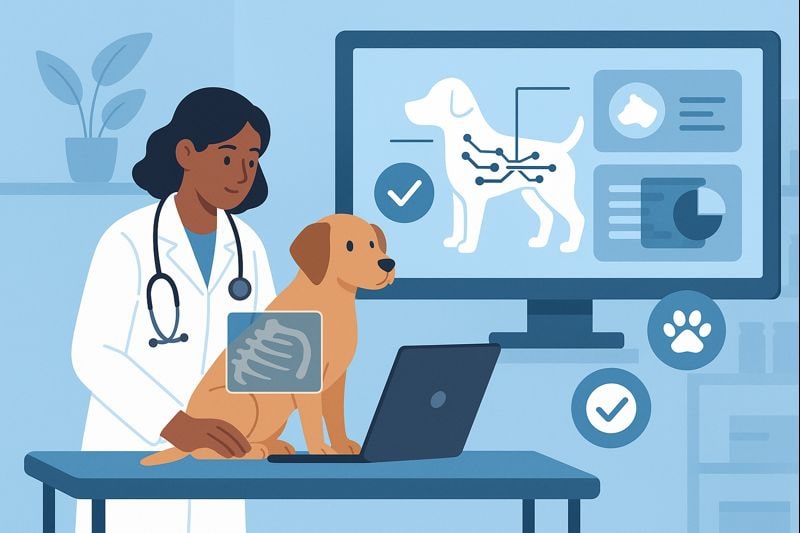
Using AI Diagnostics in Veterinary Medicine
AI diagnostics in veterinary medicine is changing how clinics find disease, confirm treatment plans, and communicate results—often faster and with more consistency than manual-only workflows.
At its core, AI diagnostics uses machine learning and computer vision to recognize patterns in medical data such as radiographs, ultrasound clips, lab values, pathology images, and even patient history notes.
The goal is not to replace clinical judgment, but to strengthen it with decision support that is always “on,” doesn’t get fatigued, and can surface subtle findings a busy team might miss.
AI diagnostics matters because veterinary teams face real-world constraints: limited specialist availability, short appointment times, and rising client expectations for fast answers.
When used responsibly, AI diagnostics in veterinary medicine can reduce turnaround time for imaging interpretation, improve triage decisions, and help standardize care across multi-doctor practices.
Professional bodies and regulators are actively working on guidance because adoption is accelerating and the technology is moving faster than traditional policy cycles.
For example, AVMA discussions have emphasized building a responsible framework for using AI tools, and veterinary regulators have published considerations that focus on safety, privacy, transparency, and accountability.
In this guide, you’ll learn how AI diagnostics in veterinary medicine works, where it performs best today, what risks to manage, and how to implement it in a way that improves outcomes and protects trust.
You’ll also see future predictions for where AI diagnostics is heading next—so you can make smart choices now without locking your clinic into the wrong workflow.
How AI Diagnostics in Veterinary Medicine Works
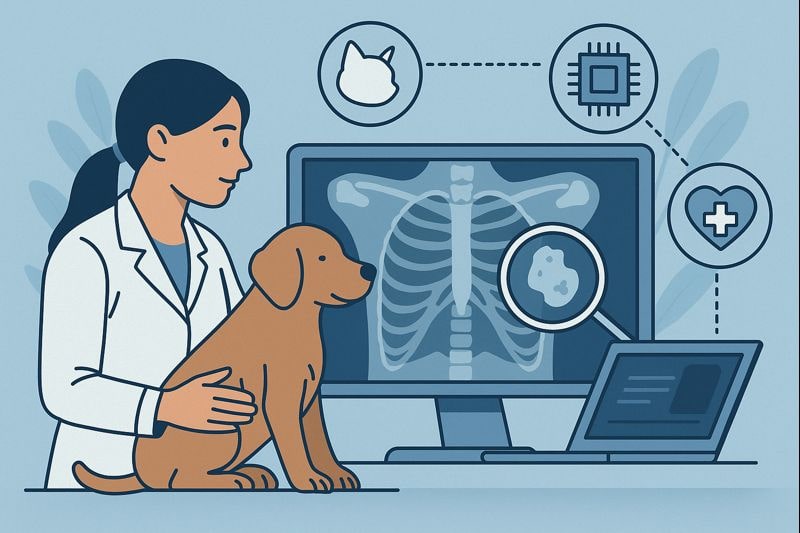
AI diagnostics in veterinary medicine typically relies on two major approaches: supervised learning and pattern-based inference across large datasets. In supervised learning, an AI model is trained on labeled examples—like radiographs marked by specialists or lab panels paired with confirmed diagnoses.
Over time, the model learns to associate certain visual or numerical patterns with likely findings. In day-to-day practice, the AI then produces outputs such as “probable cardiomegaly,” “possible pleural effusion,” “likely urinary crystals,” or “high risk of endocrine disorder,” depending on what it was trained to detect.
Most diagnostic AI tools also have a pipeline behind the scenes. Data is captured (image, waveform, text, lab values), cleaned and standardized, then analyzed. The AI produces a result that can include classifications, confidence scores, heatmaps on images, or prioritized differential lists.
That output is then reviewed by a clinician who decides what to do next. This “human-in-the-loop” model is the safest and most practical form of AI diagnostics in veterinary medicine because it treats AI as support rather than authority.
It’s important to understand that AI diagnostics is only as reliable as the data it has learned from. If the training data underrepresents certain breeds, body types, imaging positions, equipment brands, or disease prevalence patterns, performance may drift.
That’s why modern frameworks emphasize validation, monitoring, and ongoing evaluation rather than a one-time purchase decision. Veterinary journals have even described “toolbox” approaches for safer deployment—covering data quality, workflow integration, training, monitoring, ethics, and change management.
AI diagnostics in veterinary medicine also overlaps with generative AI in documentation and client communication. While generative tools don’t “diagnose” directly, they can reduce errors by improving record clarity and consistency—when implemented with safeguards.
The Biggest Clinical Use Cases for AI Diagnostics Today
AI diagnostics in veterinary medicine is already delivering measurable value in several areas, especially where pattern recognition is central and time-to-answer affects outcomes. The most common use case is diagnostic imaging support.
AI can highlight suspected abnormalities on radiographs and help general practitioners triage which cases need urgent referral. This is particularly useful in emergencies, overnight care, or clinics without easy access to a radiologist.
Another strong use case is lab interpretation support—turning raw numbers into decision-ready insights. AI diagnostics can flag results that match high-risk profiles (for example, dehydration patterns, inflammation profiles, anemia patterns, or kidney-related abnormalities) and suggest follow-up testing.
Even when a tool is not “making a diagnosis,” it can still raise the quality of care by reducing missed follow-ups and improving consistency across staff.
AI diagnostics in veterinary medicine is also expanding into dermatology, parasitology, and urinalysis. Computer vision can identify organisms or sediment features in images more consistently than manual-only review in high-volume settings.
Some diagnostic analyzer ecosystems already emphasize integrated reporting and consistent workflows, which makes it easier to layer in AI assistance.
Finally, AI diagnostics is showing momentum in predictive risk scoring: identifying which patients are at risk of chronic disease earlier based on subtle, combined signals. That includes trend analysis across repeated lab panels, weight changes, and history patterns.
AAHA has described how AI adoption is moving from narrow tools to broader support across practice operations and care delivery, which matches what many clinics are experiencing on the ground.
AI Diagnostics in Veterinary Imaging: Radiology, Ultrasound, and Beyond
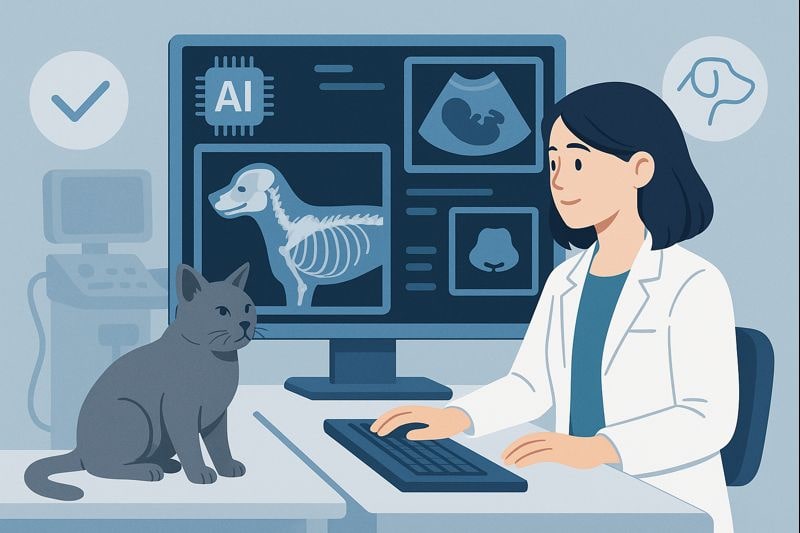
AI diagnostics in veterinary medicine has made some of its fastest progress in radiology because radiographs are standardized enough for computer vision, and many findings are pattern-based.
Modern veterinary radiology AI tools can provide a fast “second look” that flags suspected findings and encourages consistent reporting. In a busy clinic, AI diagnostics can help reduce cognitive load—especially on complex thoracic or abdominal films where subtle changes can be overlooked.
Peer-reviewed veterinary research has started to directly compare commercial AI radiology software to specialist interpretation for canine and feline studies.
One study published in Frontiers in Veterinary Science evaluated radiological interpretation performance between veterinary radiologists and state-of-the-art commercial AI software for canine and feline radiographs, reflecting the field’s growing emphasis on real-world benchmarking rather than marketing claims.
It’s also essential to recognize limits. AI diagnostics in veterinary imaging can struggle with poor positioning, motion artifacts, unusual anatomy, post-surgical changes, low-quality exposure, and rare diseases that were not well represented in training data.
That’s why the strongest model is “AI + clinician + escalation path.” If AI flags a concern or if clinical signs conflict with AI output, the next step should be a radiologist review, additional imaging, or alternative testing—not blind acceptance or dismissal.
Ultrasound is another growing frontier for AI diagnostics in veterinary medicine, but it’s more challenging because ultrasound depends on operator technique and dynamic scanning. Expect AI to show earlier wins in guided protocols (FAST exams, bladder checks, pregnancy confirmation, basic cardiac screening) where views are more repeatable.
Over time, AI may evolve into real-time scanning support that guides probe placement and automatically captures best frames—similar to how some human imaging AI tools are evolving.
AI Diagnostics in Laboratory Testing and Urinalysis Workflows
AI diagnostics in veterinary medicine doesn’t only live in imaging—it also shows up in lab workflows where speed and repeatability matter. A major advantage of AI-style automation is consistency: results don’t depend as heavily on who is working that shift, and interpretation can be standardized across multiple locations.
In practice, this can reduce repeat tests, improve confidence in borderline results, and help new team members perform at a higher level sooner.
Urinalysis is a great example of where AI-like automation and computer vision can improve repeatability. Modern urine sediment analyzers produce digital images and structured results, supporting a more consistent review process and easier consultation.
Some systems highlight advanced bacteria detection and provide high-quality images that can be reviewed, documented, and shared for second opinions.
Even when a tool is not marketed explicitly as “AI,” the benefit can be similar: automation that reduces manual variability and creates a consistent diagnostic report.
Operator guides and integrated diagnostic hubs also matter because AI diagnostics in veterinary medicine is only useful if it fits into a real clinic workflow without causing bottlenecks. Integrated systems that act as a communication hub for instruments and store patient results can make it easier to use AI-driven insights consistently across the team.
A best-practice approach is to treat AI diagnostics as “decision support” rather than “diagnosis by machine.” For lab results, that means you still apply patient context: hydration status, current medications, sample quality, and clinical signs.
AI diagnostics should speed up recognition and reduce missed patterns, but the clinician decides what the pattern means for that individual patient.
Data Quality, Bias, and Safety Risks You Must Manage
AI diagnostics in veterinary medicine can improve care, but it also introduces new risk categories that clinics must actively manage. The biggest risks are incorrect outputs, hidden bias, and over-reliance.
An AI tool can be wrong for predictable reasons—poor input quality, unusual cases, rare diseases, or domain shift (different equipment, different patient population).
It can also be wrong in ways that are harder to detect, such as systematically underperforming for certain breeds, body sizes, or age groups if those groups were underrepresented in training data. Regulatory guidance and professional frameworks emphasize transparency, privacy, and accountability.
Veterinary regulatory groups have noted that licensees and facilities remain responsible for compliance with applicable laws and practice acts, and that clinics should maintain transparency regarding AI use, protect client data, and obtain informed consent when appropriate.
Safety management for AI diagnostics in veterinary medicine should include practical controls:
- Input controls: standardized imaging positioning, minimum image quality checks, consistent sample handling.
- Output controls: clear labeling that results are AI-assisted, confidence indicators, and “when to escalate” rules.
- Monitoring controls: periodic audits comparing AI suggestions to clinician conclusions and confirmed outcomes.
- Bias controls: track performance across species, breeds, sizes, and age groups; document gaps.
- Clinical governance: assign an internal owner (medical director or quality lead) to oversee updates and performance checks.
This isn’t about distrust—it’s about clinical maturity. AI diagnostics can be extremely helpful, but safe clinics treat it like any other diagnostic instrument: validated, monitored, and used with professional judgment.
Legal, Ethical, and Client-Trust Considerations
AI diagnostics in veterinary medicine affects more than clinical decisions—it affects trust. Clients want faster answers, but they also want to know that a qualified professional is responsible for their pet’s care.
That means clinics should be proactive about communication: explain that AI diagnostics is used to support clinical judgment, not replace it. When AI is used for imaging triage, you can frame it as a rapid screening tool that helps the clinician prioritize urgent findings and decide whether specialist review is needed.
Ethically, transparency matters. Regulatory and policy discussions in the profession are increasingly focused on responsible AI frameworks.
AVMA conversations have highlighted that AI development is moving fast and guidance must catch up, which is why the profession is actively building resources around evaluation, adoption, and ethical implications.
Operationally, you’ll want to define:
- Disclosure: when and how you tell clients AI was used (especially if AI output is shared directly).
- Documentation: how AI outputs are stored in the medical record, including versioning if the tool updates.
- Accountability: who reviews AI output, and what “clinically reviewed” means in your SOPs.
- Privacy: what data leaves your clinic, whether data is used to train models, and how you secure it.
AAHA has also discussed implementation considerations for AI tools used in practice workflows (such as scribing), emphasizing that not all tools are equal and that practices should evaluate them carefully. That same mindset applies to AI diagnostics: evaluate claims, validate fit, and protect clinical standards.
The trust takeaway: the clinic owns the decision. AI diagnostics supports the decision.
Implementation Playbook: How to Adopt AI Diagnostics the Right Way
A successful rollout of AI diagnostics in veterinary medicine is less about “buying software” and more about designing a safe workflow. The first step is choosing a narrow, high-impact use case. Imaging triage, urinalysis support, and record-quality improvements are common starting points because they deliver value quickly and are easier to monitor.
Next, define your workflow. Who submits the case to the AI tool? Who reviews the output? Where does the output appear—inside the imaging system, the practice management system, or a separate portal?
The best implementation reduces clicks and avoids splitting attention across too many screens. Vendor integration matters here, but so does internal SOP design.
A strong deployment framework for AI in veterinary contexts has been described in veterinary literature as a practical “toolbox,” including team education, data quality, implementation planning, workflow integration, monitoring, and ethical obligations.
Here’s a clinic-ready adoption plan for AI diagnostics in veterinary medicine:
- Pilot phase (30–60 days): run AI diagnostics in “shadow mode,” where clinicians see AI output but don’t change decisions based solely on it. Track disagreements and learn patterns.
- Validation phase: compare AI output to radiologist reads (for imaging) or confirmed follow-up results (for labs). Create rules for when AI adds value and when it confuses decisions.
- Go-live with guardrails: turn on the workflow officially with escalation criteria (for example, “AI flags thoracic abnormality + clinical respiratory signs = radiologist consult recommended”).
- Training: give the whole team short, role-based training: technicians focus on input quality, doctors focus on interpretation and escalation, CSRs focus on client explanations.
- Ongoing monitoring: quarterly audits, update review, and documentation standards.
Implementation done right turns AI diagnostics into a reliability upgrade—not a risk multiplier.
Future Predictions: Where AI Diagnostics in Veterinary Medicine Is Headed Next
AI diagnostics in veterinary medicine is likely to evolve in three major directions: multimodal intelligence, real-time guidance, and personalized prediction.
Multimodal intelligence means the AI will combine imaging, lab trends, wearable signals, and medical history in one model—producing more context-aware outputs. Instead of “possible disease X,” future AI diagnostics may say, “Given imaging + lab trend + symptoms, disease X is more likely than Y; here are the top next tests.”
Real-time guidance is another big shift. In imaging, AI will increasingly guide acquisition, not just interpretation. That means prompting the operator to capture better views, improve positioning, or repeat a shot when quality is too low. This will reduce one of today’s biggest AI limitations: poor inputs.
Personalized prediction is the third shift. With enough longitudinal data, AI diagnostics will move earlier in the disease timeline—flagging risk before obvious symptoms appear. That could transform chronic disease management by triggering earlier diet changes, monitoring plans, or confirmatory testing.
At the professional level, expect more formal governance and guidance. AVMA reporting indicates active efforts to develop clearer policies and resources for safe AI use in both clinical and business contexts. Regulators are also issuing considerations focused on privacy, quality, transparency, and risk management.
In other words, the future of AI diagnostics in veterinary medicine is not just “more AI.” It’s better-integrated AI with clearer standards, stronger validation, and safer workflows.
FAQs
Q.1: What is the best way to explain AI diagnostics to clients without reducing trust?
Answer: The best explanation is simple and confidence-building: AI diagnostics in veterinary medicine is a support tool that helps the veterinary team review results more consistently and quickly, but the clinician remains responsible for decisions.
Clients usually respond well when you emphasize that AI does not replace the exam, the history, or the doctor’s judgment. It’s more like having an extra set of trained eyes that can highlight things worth a closer look.
A practical script is: “We use AI-assisted tools to help us interpret certain tests and images. It can quickly flag patterns that deserve attention, and it helps us be more consistent. Your pet’s diagnosis and treatment plan are always decided by the veterinary team.” Then add a benefit: faster triage, clearer reporting, or earlier detection.
If you share AI outputs (like annotated images), label them clearly as AI-assisted and note that final interpretation is clinical. This aligns with the broader direction of professional guidance emphasizing transparency and responsible use.
Finally, train your front desk team. Many trust issues happen at the communication layer, not the clinical layer. When your staff can explain AI diagnostics calmly and consistently, clients are more likely to see it as an investment in quality rather than a shortcut.
Q.2: Can AI diagnostics replace a veterinary radiologist?
Answer: In normal clinic workflow, AI diagnostics in veterinary medicine is best used as an adjunct, not a replacement. AI can be very strong at pattern recognition and fast screening, especially for common findings, but it can struggle with rare diseases, complex multi-system cases, unusual anatomy, and poor-quality inputs.
Radiologists bring something AI does not: clinical nuance, broad differential reasoning, and deep experience with atypical presentations.
Current research trends show increasing effort to benchmark commercial veterinary AI tools against specialist interpretation, which reflects both progress and the need for careful limits.
The practical model for most clinics is “AI triage + escalation.” AI helps identify cases that should be prioritized for radiologist review, and it can reduce time-to-action for urgent findings.
If your clinic is deciding between “AI tool” and “radiology service,” the safest answer is usually “both,” used strategically. Use AI diagnostics for speed and consistency, and use a radiologist for complex, high-stakes, or unclear cases—especially when clinical signs and imaging don’t align cleanly.
Q.3: What should a clinic validate before trusting an AI diagnostics tool?
Answer: Before trusting AI diagnostics in veterinary medicine, validate performance in your setting, not just in vendor demos. Start with input quality: does the AI work well on your imaging equipment, your positioning style, and your patient population? Then validate outputs: do the AI’s flags match your clinicians’ findings and follow-up confirmations?
A practical validation checklist includes:
- A shadow-mode trial where AI runs but doesn’t drive decisions.
- A sample size large enough to include common conditions and “normal” studies.
- Comparison against a reference standard (specialist reads, confirmed diagnostics, follow-up outcomes).
- Tracking of false positives and false negatives, not just “overall accuracy.”
- Review of how results are displayed (confidence, explanations, or heatmaps) and whether that reduces or increases confusion.
Veterinary guidance on safe AI deployment emphasizes building a structured implementation plan and monitoring performance over time, which is critical because tools can change with updates and data drift.
Validation is not a one-time event. AI diagnostics should be treated like an instrument that requires ongoing quality checks.
Q.4: How do we prevent over-reliance on AI diagnostics by new staff?
Answer: Over-reliance happens when people treat AI output as authority instead of assistance. The fix is workflow design and training. Make your SOP explicit: AI diagnostics in veterinary medicine provides decision support, and every AI output must be clinically reviewed.
Build “review moments” into the process—like requiring the clinician to document agreement or disagreement with AI output for certain case types during the first months of adoption.
Training should focus on failure modes. Show examples of when AI performs well (common findings, clear images) and when it fails (poor positioning, artifacts, rare conditions).
Teach staff how to handle conflicts: if the AI says “normal” but the patient is symptomatic, escalate. If the AI flags something unexpected, re-check image quality and confirm clinically.
Regulatory and professional discussions emphasize accountability remaining with the licensed professional and transparency in use. Reinforce that culturally: AI is a tool, and the clinician owns the decision.
Finally, run periodic audits and share learning. When teams see real examples of AI being wrong in predictable ways, they respect it appropriately without rejecting it.
Q.5: Does AI diagnostics improve efficiency, or does it add more steps?
Answer: AI diagnostics in veterinary medicine improves efficiency when it is integrated into the existing workflow and reduces downstream work—like repeat imaging, delayed triage, or unclear documentation.
It adds friction when it requires extra logins, manual uploads, or switching between multiple systems. That’s why integration and workflow mapping matter as much as model accuracy.
A good implementation reduces clicks and produces outputs where clinicians already work—inside imaging software, within diagnostic reporting, or in a unified results hub. Tools that already serve as diagnostic communication hubs can make consistent reporting easier and reduce the “where did that result go?” problem.
Efficiency gains also come from standardization. When AI diagnostics consistently flags common findings, clinicians can move faster on routine cases and reserve deeper analysis for complex cases. Over time, this can reduce burnout and increase appointment capacity without compromising quality.
The key is measuring efficiency with real metrics: time-to-report, time-to-treatment decision, number of rechecks, and number of escalations. If AI diagnostics doesn’t improve those, you may need a different tool or a better workflow.
Q.6: What’s the future of AI diagnostics in veterinary medicine over the next 3–5 years?
Answer: Over the next 3–5 years, AI diagnostics in veterinary medicine will likely become more multimodal, more proactive, and more governed. Multimodal means AI will combine imaging, lab trends, and history into more context-aware support.
Proactive means more prediction: identifying risk earlier and recommending targeted monitoring rather than waiting for obvious disease.
You’ll also see more real-time guidance in imaging acquisition, where AI helps technicians capture better views and reduces low-quality inputs—one of the biggest sources of diagnostic errors. Clinics will benefit from fewer repeats and more consistent records.
Governance will expand alongside adoption. AVMA reporting indicates active development of clearer guidance and resources for safe AI use in clinical and business contexts, and regulatory groups have already published considerations emphasizing transparency, privacy, and accountability.
Practically, clinics that build good SOPs now—validation, escalation rules, monitoring—will be in the best position to adopt future AI diagnostics upgrades safely without chaos.
Conclusion
AI diagnostics in veterinary medicine is no longer a futuristic idea—it’s a practical set of tools that can improve speed, consistency, and decision support across imaging, labs, and clinical workflows.
The clinics that benefit most treat AI diagnostics as a clinical instrument: they validate performance, train the team, define escalation rules, and monitor outcomes over time. That approach reduces risk while capturing the upside—faster triage, clearer documentation, and more standardized care.
The most responsible path forward is also the most effective: keep clinicians in the loop, be transparent with clients, protect data privacy, and build governance into implementation.
Professional and regulatory guidance is evolving quickly because adoption is accelerating, and that momentum will continue as AI becomes more integrated and more multimodal.