Improving Patient Flow in Veterinary Clinics
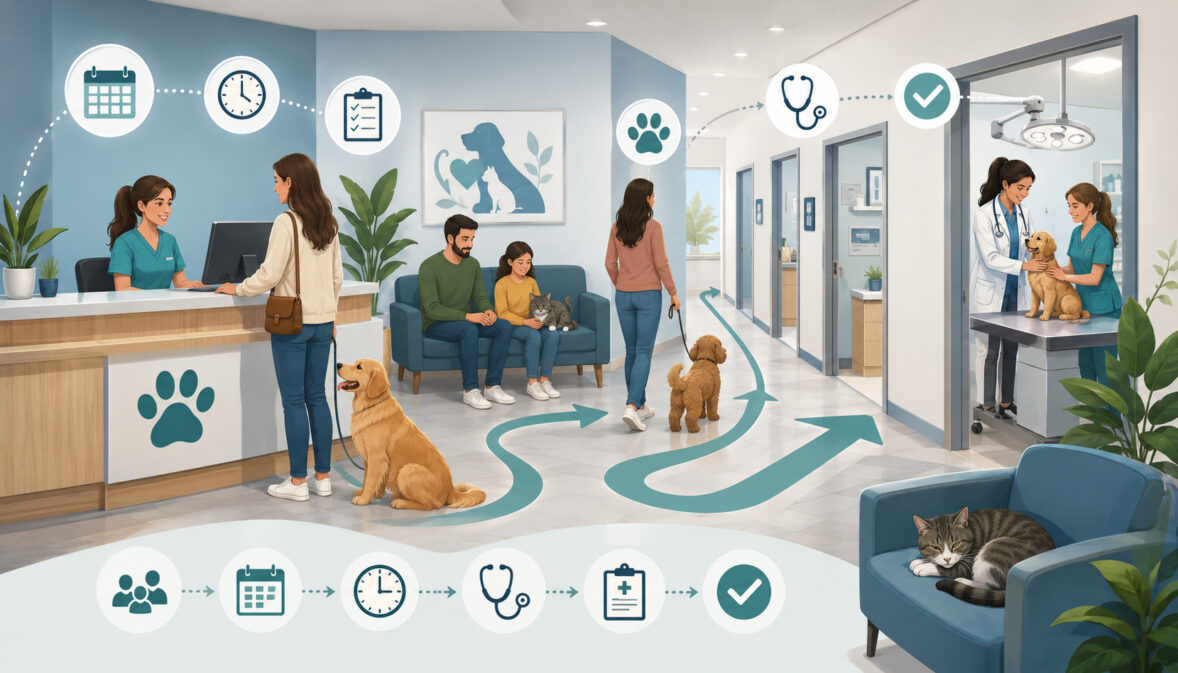
Improving patient flow in veterinary clinics means creating a smoother, safer, and more organized journey for pets, clients, and veterinary teams. It affects every stage of a visit, including appointment scheduling, arrival instructions, check-in, technician intake, doctor evaluation, diagnostics, treatment, payment, discharge, and follow-up communication.
Patient flow matters in general practices, specialty clinics, urgent care facilities, animal hospitals, surgery-focused practices, and mobile veterinary services.
When workflows are unclear, clients wait longer, pets may become more stressed, staff face repeated interruptions, exam rooms remain occupied unnecessarily, and veterinarians have less time to focus on clinical decisions.
Better flow does not mean shortening every appointment or rushing medical care. It means removing avoidable delays, clarifying staff responsibilities, improving communication, and making sure information, equipment, rooms, and supplies are available when needed.
A well-designed veterinary clinic workflow can help:
- Reduce appointment backlogs and waiting-room congestion.
- Improve exam room availability and turnover.
- Help technicians prepare veterinarians more effectively.
- Reduce repeated questions and missing information.
- Organize diagnostic, laboratory, and pharmacy tasks.
- Prepare invoices and discharge instructions earlier.
- Improve client confidence and satisfaction.
- Reduce unnecessary staff stress and overtime.
- Create more predictable daily operations.
The best approach is not to redesign the entire practice at once. Clinics can begin by mapping the patient journey, identifying the most disruptive bottleneck, testing one improvement, and measuring whether the change produces a meaningful result.
What Is Veterinary Patient Flow?
Veterinary patient flow describes how a pet and its owner move through the complete care process. It begins before the client enters the building and continues after the pet leaves.
The process may include online booking, telephone scheduling, reminders, pre-visit forms, parking instructions, check-in, waiting, technician intake, examination, diagnostics, treatment planning, estimates, consent, procedures, payment, discharge instructions, laboratory updates, follow-up calls, and future reminders.
Veterinary patient flow should not be viewed only as physical movement between the waiting room, exam room, treatment area, and checkout desk. Information must also move accurately between receptionists, veterinary technicians, assistants, veterinarians, laboratory staff, pharmacy staff, managers, and clients.
A clinic can appear calm while still having serious workflow problems. For example, a pet may be waiting quietly in an exam room while the veterinary team searches for outside records, confirms medication doses, finds supplies, enters diagnostic orders, or waits for an estimate to be approved.
Improving veterinary clinic patient flow therefore requires attention to three connected elements:
- The movement of patients and clients.
- The movement of clinical and administrative information.
- The movement of tasks between team members.
Patient Flow Is More Than the Exam Room
A successful appointment depends on many events that happen before and after the veterinarian enters the exam room. Reception may need to confirm the reason for the visit, collect records, identify whether the client is new, and determine whether forms are complete.
A technician or assistant may then collect the history, review medications, document the client’s main concerns, record appropriate vital information, and prepare the patient for the veterinarian. After the examination, the team may need to coordinate diagnostics, treatment plans, consent forms, medication dispensing, invoices, payment, and discharge instructions.
Follow-up is also part of veterinary patient flow. Laboratory results, callbacks, prescription questions, recheck appointments, and reminder messages must be assigned and completed. A delay at any point can affect several appointments that follow.
Practices examining their broader veterinary practice management systems should evaluate whether scheduling, medical records, billing, reminders, inventory, and laboratory information work together or create duplicate steps.
Why Patient Flow Breaks Down
Patient flow usually breaks down because several small delays accumulate. A single missing form may take only a few minutes to resolve, but repeated delays across many appointments can disrupt the entire schedule.
Common causes include:
- Appointment types that do not match the time reserved.
- Incomplete registration forms or missing medical records.
- Late arrivals without a consistent response process.
- Urgent cases added without adjusting other appointments.
- Exam rooms that are not cleaned or restocked.
- Unclear technician-to-doctor handoffs.
- Diagnostic orders waiting to be entered.
- Samples that are not labeled or routed promptly.
- Treatment plans or estimates prepared too late.
- Charges that are not entered before checkout.
- Discharge instructions written after the client is ready to leave.
- Callbacks and pending results without a clear owner.
These problems are rarely the fault of one department. Veterinary patient flow is a whole-practice responsibility because one team’s unfinished task becomes another team’s delay.
Veterinary Patient Flow at a Glance
The following table provides a practical overview of the major stages in the patient journey. Practice managers can use it to compare current workflows with the areas most likely to affect veterinary clinic efficiency.
| Patient Flow Area | What to Improve | Why It Matters | Priority |
| Scheduling | Appointment types, realistic time blocks, buffers and urgent slots | Controls the pace of the day | High |
| Check-in | Forms, medical records and arrival instructions | Reduces front desk delays | High |
| Waiting room | Updates, cleanliness and stress reduction | Improves the client and pet experience | Medium/High |
| Exam room intake | History, medications, visit reason and appropriate vitals | Helps the doctor prepare | High |
| Doctor handoff | Clear summary of concerns and relevant history | Reduces repeated questions | High |
| Treatment area | Diagnostics, procedures and patient movement | Prevents clinical bottlenecks | High |
| Checkout | Charges, payment and discharge instructions | Reduces end-of-visit delays | High |
| Follow-up | Results, callbacks, rechecks and reminders | Supports continuity of care | High |
| Staff roles | Task ownership and delegation | Reduces confusion | High |
| Metrics | Wait time, appointment length, room turnover and no-shows | Guides improvement | Medium/High |
The table should be adapted to the clinic’s actual operating model. A small practice may combine reception, checkout, and client communication responsibilities, while a larger hospital may divide these functions among several teams.
How to Use the Table
Begin by rating each patient flow area as stable, inconsistent, or frequently delayed. Staff members should provide examples rather than general opinions.
For instance, saying that checkout is “slow” is less useful than documenting that invoices are often incomplete when clients reach reception. Similarly, saying that exam rooms are “always full” provides less direction than recording how long rooms remain occupied after the medical discussion has ended.
Managers can observe several representative appointments and record:
- When the client arrives.
- When check-in is completed.
- When the patient enters an exam room.
- When technician intake begins and ends.
- When the veterinarian enters.
- When diagnostics or treatment begins.
- When the invoice is ready.
- When payment and discharge are completed.
The purpose is not to time staff in a punitive way. It is to understand where work stops, waits, repeats, or moves backward.
Why Patient Flow Priorities Differ by Clinic
A single-doctor general practice may struggle most with telephone interruptions and prescription requests. A multi-doctor hospital may experience room assignment conflicts, uneven technician coverage, or delays moving patients to diagnostics.
Emergency and urgent care practices need flexible triage and communication processes because patient order can change quickly. Specialty clinics may require longer consultations, outside records, complex diagnostics, or coordination with referring veterinarians.
Surgery-heavy practices may focus on drop-off flow, consent forms, pre-procedure testing, recovery monitoring, discharge timing, and medication preparation. Mobile practices may prioritize route planning, client readiness, equipment organization, connectivity, and documentation between visits.
For this reason, the best ways to streamline veterinary patient flow depend on patient volume, services, staffing, building layout, case complexity, and client expectations. Clinics should avoid copying another practice’s process without first testing whether it fits their own environment.
Map the Complete Patient and Client Journey
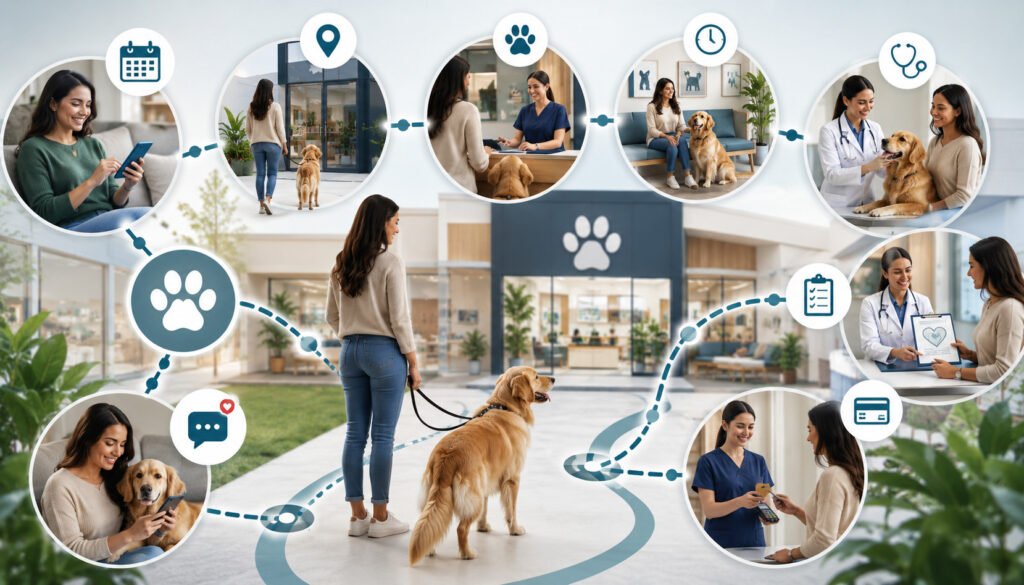
Mapping the patient journey is one of the most useful first steps in improving patient flow in veterinary clinics. It shows what clients, patients, information, and staff must do at each stage.
Start with the first point of contact. This could be an online booking request, telephone call, referral, portal message, prescription request, or urgent inquiry. Continue through scheduling, reminders, forms, arrival, check-in, intake, examination, diagnostics, treatment, checkout, discharge, and follow-up.
At each stage, identify:
- Who is responsible?
- What information is needed?
- Where is that information recorded?
- What must happen before the next step begins?
- What commonly causes the work to stop?
- How does the next team member know the task is ready?
- What happens if the normal process changes?
The map should reflect both the patient journey and the client journey. A pet may move efficiently into treatment while the client waits without an update. Likewise, a client may complete payment quickly while discharge medications remain unfinished.
Observe the Real Workflow
Written standard operating procedures show how a process is intended to work. Observation reveals what actually happens during a busy day.
Clinic leaders should follow a small sample of appointments from beginning to end. Include different visit types, such as a wellness examination, sick visit, technician appointment, urgent case, new client visit, and surgery discharge.
Watch for repeated movement, interruptions, and workarounds. A technician may walk to the pharmacy several times because rooms are not stocked consistently. A veterinarian may leave the exam room to find laboratory results that were imported into a separate system. Reception may repeatedly ask the medical team whether an invoice is complete.
Staff feedback is essential because employees often create informal workarounds that managers do not see. These workarounds may keep the day moving temporarily while hiding a larger system problem.
Look for Repeated Delays
One unusual delay does not always require a workflow redesign. Repeated delays indicate a system issue.
Track delays by category rather than recording only the total wait time. Useful categories include missing forms, unavailable records, late arrival, room unavailable, doctor delayed, technician unavailable, diagnostics pending, estimate pending, client decision pending, invoice incomplete, medication pending, and discharge pending.
Patterns may reveal that:
- New client appointments need earlier record collection.
- Senior pet visits require longer scheduling blocks.
- Technician appointments are being interrupted by refill requests.
- Exam rooms lack commonly used supplies.
- Diagnostic samples wait because no person owns the next step.
- Checkout slows because charges are entered after treatment.
- Follow-up calls are delayed because they are assigned too broadly.
Once the most frequent source of delay is known, the clinic can improve one process rather than making several unrelated changes.
Improve Veterinary Appointment Flow
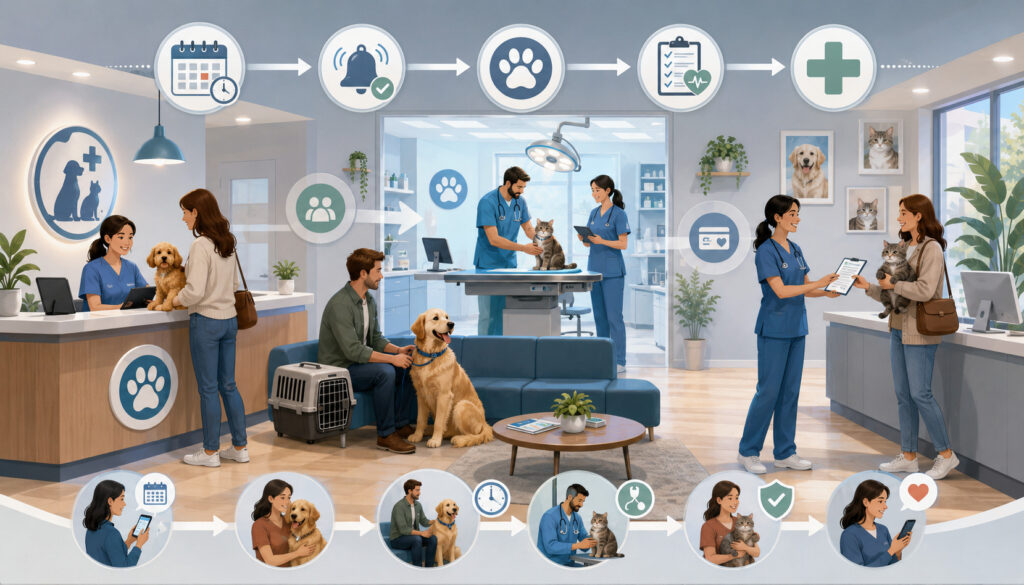
The veterinary scheduling workflow creates the operating framework for the day. When appointment categories, time blocks, staffing, rooms, and expected complexity do not match, delays become difficult to avoid.
Clinics should define appointment types clearly. Categories may include wellness visits, new client appointments, sick visits, chronic care rechecks, senior pet examinations, behavior consultations, technician services, surgery admissions, dental admissions, urgent visits, and discharge appointments.
Each category should have a realistic time block and preparation requirements. A new client with incomplete records generally requires more administrative work than an established client returning for a focused recheck.
Online booking can improve convenience, but booking choices must be specific enough to direct clients toward the correct visit type.
Requests involving breathing difficulty, severe injury, toxin exposure, uncontrolled bleeding, collapse, or other urgent concerns should be routed according to the clinic’s clinical triage procedures rather than treated as routine online appointments.
Match Appointment Length to Visit Type
Using the same appointment length for every patient may appear simple, but it can create uneven veterinary appointment flow. Visit complexity differs according to the patient’s condition, history, client concerns, diagnostics, mobility, behavior, and communication needs.
A preventive visit for an established patient may be relatively predictable. A senior pet with several medications and multiple concerns may require additional history review, examination time, diagnostic discussion, and treatment planning.
Practices can review historical appointment data to compare scheduled time with actual completion time. The objective is not to force every visit into a strict limit. It is to create scheduling categories that reflect normal workload.
Reception teams need clear guidance about which category to select. Asking the client for the main concern, number of concerns, duration of symptoms, current medications, and whether records are available can support more accurate scheduling without attempting to make medical decisions.
Build Buffers and Manage Disruptions
Appointment buffers help absorb normal variation, including late arrivals, complex discussions, urgent cases, diagnostic delays, and medical record updates. Buffers can be placed between demanding appointments, around urgent slots, or at specific points during the day.
A buffer should not automatically become another appointment opening. Its purpose is to protect the rest of the schedule when an earlier visit requires more time.
No-shows and late arrivals also need consistent processes. Clinics can use text messages, emails, telephone calls, or portal notifications to confirm appointments. Messages should explain arrival expectations, forms, medication information, sample requests, parking instructions, and how to reschedule.
A cancellation waitlist can fill appropriate openings without overbooking. The list should identify the visit type, preferred provider, time availability, and how quickly the client can arrive.
Policies involving deposits, cancellation fees, refunds, or financial arrangements should be reviewed with qualified legal, accounting, and payment professionals before implementation.
Streamline Check-In, Intake Forms, and Waiting
The veterinary check-in process should confirm essential information without forcing the client to repeat everything already provided. An efficient check-in workflow verifies identity, contact information, patient details, visit purpose, records, medications, consent requirements, and communication preferences.
New clients may need additional time because patient history, vaccine information, previous diagnostics, referral documents, and medication lists must be collected. Requesting these materials before the appointment allows the medical team to review them earlier.
Digital intake forms can reduce front desk congestion when they are short, mobile-friendly, secure, and connected to the correct patient record. Forms should collect information that the team will actually use.
Useful pre-visit questions may include:
- What is the primary reason for the visit?
- When did the concern begin?
- What medications or supplements is the pet receiving?
- Have appetite, thirst, elimination, activity, or behavior changed?
- Are outside medical records available?
- Are there handling concerns or known stress triggers?
- Does the client have additional questions for the veterinarian?
Collect Information Before Arrival
Pre-visit tools allow the team to identify missing information before the client reaches reception. They can also help determine whether records, medication details, photographs, questionnaires, or samples are needed.
A reminder message should provide a direct link to the correct form and explain when it should be submitted. Sending every client the same long questionnaire may reduce completion rates.
Appointment-specific forms are often more effective. A behavior consultation may need environmental and behavioral history, while a recheck may require updates about medication response and changes since the previous visit.
Mobile tools, client portals, and online forms can support veterinary patient flow by reducing telephone calls and allowing clients to provide information before arrival. However, clinics should retain an accessible alternative for clients who cannot use digital tools.
Improve the Waiting Room Experience
Waiting time feels longer when clients receive no information. At check-in, staff should explain what happens next, where the client should wait, and how updates will be provided.
Pet stress should be considered when designing veterinary clinic patient flow. Noise, crowding, unfamiliar animals, close seating, slippery surfaces, and prolonged waiting may increase anxiety or make safe handling more difficult.
Depending on the facility, clinics may use:
- Separate seating areas where practical.
- Direct-to-room placement when a room is available.
- Vehicle waiting with text or telephone notification.
- Visual barriers between animals.
- Clear leash and carrier expectations.
- Prompt cleaning of accidents.
- Proactive updates when delays occur.
When urgent cases change the schedule, staff should acknowledge the delay without sharing another patient’s confidential information. Consistent, respectful communication can preserve trust even when the exact wait time is uncertain.
Official veterinary client communication guidance emphasizes the importance of clear, relationship-building conversations in supporting care and client understanding.
Optimize Exam Rooms, Technician Intake, and Handoffs
Veterinary exam room flow depends on room availability, consistent stocking, cleanliness, patient needs, provider assignments, and clear communication. A room should be ready for the appointment type before the patient enters whenever practical.
Standardized room layouts reduce unnecessary movement. Commonly used supplies should be stored in consistent locations, with clear minimum stock levels and restocking responsibility.
Each room may have a turnover checklist covering:
- Removal of used materials.
- Cleaning and disinfection according to clinic protocols.
- Safe disposal of sharps and waste.
- Replacement of table coverings where applicable.
- Restocking of routine supplies.
- Checking equipment readiness.
- Updating the room’s status.
Room turnover should be efficient, but sanitation and patient safety should never be shortened merely to improve a metric. Clinics should follow applicable workplace, infection-control, medical-waste, and professional requirements.
Official workplace safety standards describe controls for occupational exposure and sharps-related hazards; clinics should consult qualified professionals about how relevant requirements apply to their operations.
Technician Intake Sets Up the Appointment
Organized technician intake gives the veterinarian a clear starting point. It should capture the client’s primary concern, relevant history, medications, diet, behavior, previous treatment response, and other appointment-specific information.
Structured intake questions improve consistency, but the process should not feel mechanical. Team members need enough flexibility to identify concerns that do not fit a standard form.
The intake summary should separate observations from client-reported information. It should also make urgent concerns visible rather than burying them in a long note.
When appropriate to the clinic’s protocols and the team member’s authorized role, intake may also include weight, relevant measurements, medication reconciliation, sample collection, or preparation for the examination.
The veterinarian should be able to review the most important information quickly. Long copied notes with no clear summary may increase documentation without improving veterinary practice efficiency.
Strengthen Doctor-Technician Handoffs
A good handoff tells the veterinarian what matters without requiring the client to restart the entire conversation. The technician or assistant can summarize the visit reason, timing, medications, significant history, client priorities, relevant observations, and any urgent concern.
The handoff should also identify what remains incomplete. For example, outside records may still be pending, a medication dose may require confirmation, or the client may have several concerns that need prioritization.
After the veterinarian’s evaluation, the handoff moves in the other direction. The medical team must understand the diagnostic plan, treatment plan, estimate requirements, consent status, samples, medications, discharge tasks, and follow-up timing.
Clear task ownership is essential. Statements such as “someone needs to call the client” or “we still need the estimate” create ambiguity. Assigning the task to a role or named team member makes completion more reliable.
Improve Treatment, Laboratory, and Pharmacy Workflows
The veterinary treatment area workflow often becomes a central bottleneck because multiple doctors, technicians, assistants, diagnostic tasks, hospitalized patients, and procedures compete for the same space and equipment.
Organizing treatment zones by function can reduce unnecessary movement. A clinic may designate areas for sample preparation, laboratory testing, medication preparation, minor procedures, imaging preparation, recovery, and commonly used supplies.
The exact layout depends on the facility, but frequently used items should be accessible without blocking another team’s work. Inventory shortages can interrupt treatment, delay appointments, and create urgent ordering.
A consistent veterinary clinic workflow should connect supply use, medication dispensing, reordering, billing, and patient records where practical.
Streamline Laboratory and Diagnostic Flow
Diagnostic flow includes order entry, patient identification, sample collection, labeling, testing, imaging coordination, reference laboratory pickup, result review, client notification, and medical record documentation.
Each sample should follow the clinic’s identification and handling procedures. Staff should be able to see whether a test has been ordered, collected, processed, sent, resulted, reviewed, and communicated.
Pending results require a defined owner. Depending on the practice, responsibility may belong to the ordering veterinarian, assigned technician, laboratory coordinator, or callback team.
A shared results queue can help, but it must distinguish between results awaiting review and results awaiting client communication. Completed communication should be documented according to practice procedures.
Clinics should also define what happens when results arrive after the ordering veterinarian has left, when a result requires prompt attention, or when the client cannot be reached.
Improve Pharmacy and Prescription Refill Flow
Routine prescription requests should not repeatedly interrupt exam rooms and treatment areas. A structured refill workflow can collect requests through a dedicated telephone option, portal, form, or message queue.
The request should include the patient, medication, strength, directions, remaining supply, preferred pickup or delivery method, and requested completion date. Staff should then verify the record, approval status, inventory, labeling, payment requirements, and client notification.
A refill tracker can show whether the request is awaiting record review, veterinarian approval, preparation, payment, or pickup. This reduces duplicate calls and prevents requests from being lost between systems.
Animal drug dispensing, prescribing, labeling, and veterinarian-client-patient relationship requirements vary by medication and jurisdiction. Clinics should use official animal drug guidance and consult licensed veterinary and legal professionals for specific requirements.
Prepare Checkout, Payment, and Discharge Earlier
The veterinary check-out process begins before the client reaches reception. Charges, treatment codes, medications, diagnostics, estimates, deposits, discounts, and follow-up instructions should be reviewed as the visit progresses.
Slow checkout can weaken an otherwise positive experience. After a long or emotional appointment, clients may become frustrated if they must wait while staff reconstruct the invoice, locate medications, print instructions, or determine whether a recheck is needed.
Real-time charge capture can reduce these delays. Team members should understand who enters each service and when the invoice is reviewed.
Before the client leaves the exam room or treatment area, the team should confirm:
- The medical plan has been explained.
- Required consent has been documented.
- Medications are ready or their status is clear.
- Charges have been entered and reviewed.
- Written instructions are available.
- Follow-up timing has been established.
- The client knows where to go next.
Improve Veterinary Payment Flow
Offering practical payment methods can reduce front desk congestion and make checkout more flexible. Depending on the clinic’s systems and policies, options may include card payments, ACH payments, contactless transactions, mobile payments, secure payment links, or deposits for selected services.
Payment options should be explained before treatment whenever costs may be significant. Estimates should show what is included, what may change, and when additional authorization may be needed.
Secure payment links can allow a client to complete payment from an exam room, vehicle, or remote location. However, payment convenience should not weaken information security.
Clinics should not store card or bank details in unsecured notes, email messages, spreadsheets, or unprotected paper files. Official payment data security guidance explains basic safeguards for businesses that accept card payments.
Practices should work with qualified payment compliance professionals and their payment providers to determine applicable responsibilities.
Make Discharge Clear and Actionable
Discharge instructions should answer the client’s most important questions:
- What should I do at home?
- How and when should medications be given?
- Are there activity, feeding, wound-care, or monitoring instructions?
- What changes should prompt a call?
- When will results be available?
- When is the recheck?
- Whom should I contact with questions?
Instructions should be prepared during the appointment rather than written only after the client is waiting. Templates can improve consistency, but they must be reviewed and individualized for the patient.
Whenever practical, a team member should review the instructions verbally and give the client an opportunity to ask questions. Asking the client to explain the most important next steps in their own words can help identify misunderstandings.
Follow-up calls, result notifications, and recheck reminders should be entered into a trackable system with a due date and responsible person.
Use Team Huddles and Clear Task Ownership
A short team huddle creates shared awareness before appointments begin. It can reduce surprises and help departments prepare for expected pressure points.
The morning huddle may cover:
- Staffing assignments and absences.
- New clients and incomplete records.
- Complex or anxious patients.
- Surgery and procedure schedules.
- Urgent appointment availability.
- Patients requiring special handling or room placement.
- Expected diagnostic or inventory needs.
- Important client communication concerns.
- Likely discharge or checkout demands.
The huddle should focus on operational preparation rather than lengthy case discussion. A visual schedule, shared dashboard, or printed planning sheet can help the team see provider assignments, room needs, technician coverage, and time-sensitive tasks.
A midday review may be useful when urgent cases, late arrivals, staffing changes, or complex appointments disrupt the original plan.
Unclear Ownership Slows Patient Flow
Tasks are easily missed when responsibility is shared vaguely. If everyone is responsible for checking pending laboratory results, no one may know who must act first.
Each recurring task should have a primary owner and a backup process. Examples include:
- Who reviews online appointment requests?
- Who obtains missing records?
- Who restocks each exam room?
- Who monitors the laboratory queue?
- Who prepares medications?
- Who completes discharge instructions?
- Who reviews incomplete invoices?
- Who tracks callbacks?
- Who closes open tasks at the end of the day?
Role clarity does not prevent teamwork. It creates a dependable starting point and makes it easier to request help when workload changes.
Match Tasks to Skill and Authorized Role
Appropriate delegation helps veterinarians focus on work that requires their clinical authority while allowing technicians, assistants, reception staff, and other team members to use their training effectively.
Task assignment must reflect applicable professional rules, clinic policies, supervision requirements, patient condition, and individual competency. It should never be based only on speed.
Cross-training can strengthen resilience during absences or busy periods. However, every employee should understand the boundaries of the role they are covering.
Managers should also watch for uneven task distribution. A highly capable technician may become the default person for every difficult task, creating interruptions and burnout. Sustainable veterinary practice efficiency requires clear roles, balanced workload, training, and reliable backup.
Use Technology Without Creating More Friction
Technology can support improving patient flow in veterinary clinics when it reduces duplicate work and makes the next action visible.
Useful tools may include practice management software, online booking, digital intake forms, automated reminders, electronic medical records, SOAP note templates, client portals, laboratory integrations, inventory systems, payment links, task queues, and reporting dashboards.
The system should help team members answer basic workflow questions:
- Has the client completed the form?
- Has the patient arrived?
- Which room is ready?
- Is technician intake complete?
- Is the veterinarian ready?
- Are diagnostics pending?
- Has the estimate been approved?
- Is the invoice complete?
- Are medications ready?
- Has follow-up been assigned?
Technology should not require employees to enter the same information into several programs. Disconnected tools can create duplicate records, inconsistent statuses, missed updates, and confusion about which system is authoritative.
Choose Tools That Support the Workflow
Before purchasing or changing software, map the desired process. A new platform cannot correct unclear responsibilities by itself.
Evaluate whether the tool:
- Integrates with existing records and billing.
- Supports appointment-specific forms.
- Provides useful status indicators.
- Reduces manual data entry.
- Allows role-based access.
- Records task ownership and completion.
- Supports secure client communication.
- Produces useful operational reports.
- Has a workable downtime process.
- Can be learned without disrupting patient care.
The clinic’s technology selection should support the veterinary scheduling workflow, medical documentation, laboratory flow, pharmacy tasks, client communication, payment, and reporting.
Protect Data and Plan for Downtime
Digital workflows require secure access, appropriate permissions, backups, staff training, and response plans. Clinics should review how client details, patient records, payment information, employee information, and operational data are accessed and stored.
A broader guide to veterinary clinic patient flow and data security can help managers consider access controls, authentication, backups, mobile devices, and staff awareness.
Downtime procedures are equally important. Staff should know how to register arrivals, access critical patient information, record treatments, process urgent payments, and reconcile information after systems return.
Cybersecurity, privacy, payment security, medical records, and data-retention obligations can vary. Clinics should consult qualified cybersecurity, legal, insurance, and compliance professionals about specific requirements.
Measure Veterinary Patient Flow Performance

Patient flow metrics help clinics determine whether changes are working. Metrics should identify system problems rather than create pressure to rush appointments or blame individual employees.
Useful measurements include:
- Average time from arrival to completed check-in.
- Average wait before technician intake.
- Average wait between technician intake and doctor entry.
- Average appointment length by visit type.
- Exam room turnover time.
- Percentage of appointments starting within the clinic’s target range.
- Late arrival and no-show rates.
- Diagnostic turnaround time.
- Time from medical completion to invoice readiness.
- Average checkout time.
- Percentage of callbacks completed by the due date.
- Staff overtime linked to unfinished records or tasks.
- Client feedback about communication and waiting.
Averages should be interpreted carefully. A few highly complex cases can distort the result. Comparing medians, ranges, appointment types, providers, and time-of-day patterns may provide a more useful picture.
Start With a Few Meaningful Metrics
Tracking too many numbers can create administrative work without producing action. Begin with the metric most closely connected to the clinic’s largest bottleneck.
If clients wait too long after arrival, track arrival-to-intake time and categorize the reason for each delay. If checkout is the problem, track medical-completion-to-invoice-ready time and invoice-ready-to-departure time.
Set a baseline before changing the workflow. After a pilot period, compare results while also gathering staff and client feedback.
A faster process is not automatically better. Review whether the change affected accuracy, communication, patient stress, staff workload, or safety.
Veterinary Patient Flow Checklist
| Patient Flow Area | Question to Ask | Why It Matters | Priority |
| Scheduling | Are visit types and time blocks clear? | Reduces overbooking | High |
| Reminders | Are confirmations and instructions sent early? | Reduces missed visits and confusion | High |
| Check-in | Are forms and records collected before arrival? | Speeds registration | High |
| Exam rooms | Are rooms cleaned, stocked and clearly assigned? | Improves room availability | High |
| Technician intake | Are histories and client concerns complete? | Supports doctor preparation | High |
| Handoffs | Are key details and next steps summarized? | Reduces repetition and rework | High |
| Treatment area | Are supplies, diagnostics and patient movement organized? | Prevents clinical delays | High |
| Checkout | Are charges, medications and instructions ready? | Speeds departure | High |
| Follow-up | Are results and callbacks assigned? | Supports continuity | High |
| Metrics | Are delays categorized and reviewed? | Guides improvement | Medium/High |
Use the checklist during workflow observations, staff meetings, huddles, and improvement projects. Keep schedule reports, wait-time observations, room-turnover notes, staff feedback, client feedback, callback logs, payment reports, and action plans organized so changes can be evaluated consistently.
Common Mistakes and a Step-by-Step Improvement Plan
One of the most common mistakes is adding more appointments before correcting existing bottlenecks. If exam rooms, staffing, treatment areas, invoices, or discharge processes are already strained, additional bookings may increase waiting, overtime, and frustration without creating sustainable capacity.
Another mistake is treating patient flow as a front desk problem. Reception may be the first place clients see a delay, but the cause may be incomplete medical records, unavailable rooms, weak handoffs, missing supplies, slow diagnostics, delayed charges, or unfinished discharge instructions.
Other common mistakes include:
- Using one appointment length for every visit.
- Ignoring patterns in late arrivals.
- Sending long or irrelevant intake forms.
- Failing to restock rooms consistently.
- Allowing refill requests to interrupt clinical work.
- Leaving estimates and invoices until the end.
- Assigning callbacks without a due date.
- Buying technology without redesigning the workflow.
- Tracking data without acting on it.
- Changing several processes at the same time.
Improve One Bottleneck First
Begin with the delay that has the greatest effect on patients, clients, and staff. It may be scheduling, check-in, room availability, technician intake, treatment flow, diagnostics, checkout, or follow-up.
Use the following framework:
- Observe the current process.
- Gather examples from affected staff.
- Measure the delay for a representative period.
- Identify the most common cause.
- Design one practical change.
- Define who is responsible.
- Train the affected team.
- Pilot the change with one provider, appointment type, department, or day.
- Measure the result.
- Adjust before expanding.
For example, a clinic with slow checkout might pilot real-time charge entry and earlier discharge preparation for one appointment category. The team can then compare checkout times, invoice corrections, staff workload, and client feedback.
Involve the Whole Team
Receptionists understand booking questions, late arrivals, client frustration, and checkout delays. Technicians and assistants see intake gaps, room problems, treatment bottlenecks, and supply shortages. Veterinarians see missing information, documentation demands, diagnostic delays, and communication challenges.
Kennel staff, pharmacy staff, laboratory coordinators, inventory leads, and managers also understand parts of the workflow that others may overlook.
Team involvement improves practicality and adoption. Employees are more likely to follow a new process when they understand the problem, help design the solution, and can report what is not working.
The goal is not to create a perfect workflow that never changes. It is to build a process that can adapt while protecting patient safety, communication quality, and staff sustainability.
How Better Patient Flow Supports Practice Growth
Better animal hospital patient flow can create additional appointment capacity, but growth should be viewed as a result of reduced waste rather than faster medical decisions.
When forms are completed earlier, rooms are ready, intake is structured, handoffs are clear, diagnostics are tracked, and invoices are prepared promptly, staff spend less time searching, repeating, waiting, and correcting.
More predictable operations may improve:
- Appointment availability.
- Client satisfaction.
- Team communication.
- Staff morale and retention.
- Technician utilization.
- Room and equipment use.
- Follow-up completion.
- Payment collection and reconciliation.
- Reporting accuracy.
- Managerial decision-making.
Improved flow also helps a growing practice identify when additional staff, rooms, equipment, or operating hours are genuinely needed. Without a stable workflow, leaders may add resources without correcting the process that creates the bottleneck.
Better Flow Improves Client Confidence
Clients notice whether the clinic appears prepared. They experience the clarity of arrival instructions, the consistency of staff communication, the number of repeated questions, the length of unexplained waits, and whether instructions are ready when the visit ends.
An organized clinic does not need to appear hurried. Calm communication, accurate handoffs, visible coordination, and respectful updates can build confidence even when a case is complex.
Clients are also more likely to understand recommendations when the team presents information consistently. Clear estimates, treatment plans, medication instructions, and follow-up expectations reduce uncertainty.
Better Flow Helps Staff Work Sustainably
Repeated interruptions, missing information, unclear assignments, and unfinished tasks contribute to stress. Staff may stay late to complete records, return calls, reconcile invoices, restock rooms, or find work that was never clearly assigned.
A reliable workflow makes the next step visible and gives employees a clear way to request assistance. It also helps managers distinguish between a training issue, staffing shortage, technology problem, scheduling problem, and process problem.
Improving patient flow cannot eliminate every difficult day. Urgent cases, complex medical decisions, emotional conversations, equipment problems, and unexpected absences will still occur. Better systems give the team more capacity to respond without allowing one disruption to affect every remaining appointment.
Frequently Asked Questions
What does improving patient flow in veterinary clinics mean?
It means organizing how pets, clients, information, rooms, supplies, and staff tasks move through the practice. The process begins with scheduling and continues through check-in, intake, examination, diagnostics, treatment, payment, discharge, and follow-up.
The objective is to reduce avoidable waiting and confusion without rushing patient care. Better flow helps the team prepare earlier, communicate more clearly, and complete each transition reliably.
How can a veterinary clinic reduce wait times?
Begin by separating the total wait into stages. Measure arrival to check-in, check-in to intake, intake to doctor entry, medical completion to invoice readiness, and invoice readiness to departure.
Once the longest stage is identified, categorize the causes. Common improvements include better appointment types, pre-visit forms, schedule buffers, consistent room stocking, structured handoffs, real-time charge entry, and proactive delay updates.
What causes poor veterinary patient flow?
Poor flow is often caused by several small problems rather than one major failure. Examples include unclear scheduling categories, missing records, incomplete forms, late arrivals, unavailable rooms, weak handoffs, supply shortages, delayed diagnostics, unfinished invoices, and unassigned callbacks.
Poor communication between departments can make these problems worse because staff do not know whether a patient or task is ready for the next step.
How can scheduling improve veterinary clinic patient flow?
Scheduling should reflect the normal workload of each visit type. Wellness examinations, new client visits, chronic care rechecks, senior pet visits, behavior consultations, technician services, urgent cases, and surgery admissions may require different time blocks.
Buffers, urgent appointment capacity, confirmation messages, cancellation waitlists, and clear late-arrival procedures can help the clinic respond to normal variation without overloading the day.
How do exam rooms affect veterinary patient flow?
Exam rooms affect how quickly patients can be placed, evaluated, and transitioned to the next stage. Inconsistent stocking, unclear room status, delayed cleaning, missing equipment, and poor room assignment can create unnecessary waiting.
Standard room layouts and turnover checklists can improve readiness. Sanitation, safe waste handling, and patient comfort should remain central to every turnover process.
How can checkout be improved in a veterinary clinic?
Checkout improves when charges, medications, discharge instructions, and recheck plans are prepared before the client reaches reception. Real-time charge entry and clear responsibility for invoice review can prevent front desk delays.
Practical payment options and secure payment links may also reduce congestion. Clinics should protect payment information and consult qualified professionals about payment security and compliance requirements.
What patient flow metrics should veterinary clinics track?
Useful metrics include average wait time, appointment length by visit type, room turnover time, late-arrival rate, no-show rate, checkout time, callback completion, diagnostic turnaround time, and staff overtime.
Start with a small number of metrics connected to the clinic’s main problem. Use the data to improve systems rather than compare or blame individual employees.
What are the best ways to streamline veterinary patient flow?
Map the complete journey, define appointment types, build schedule buffers, collect information before visits, keep rooms stocked, standardize technician intake, strengthen handoffs, organize treatment zones, track results and refills, prepare invoices early, and assign follow-up tasks.
Test one change before redesigning the entire practice. Involve every affected role, train the team, measure the results, and adjust the process based on patient safety, client communication, and staff workload.
Conclusion
Improving patient flow in veterinary clinics helps reduce avoidable waiting, organize exam room use, strengthen technician and doctor handoffs, improve treatment area coordination, speed up checkout, and create more predictable daily operations.
Better veterinary patient flow does not mean rushing examinations, shortening necessary conversations, or allowing efficiency targets to replace clinical judgment. It means removing unnecessary friction so veterinary professionals can focus more effectively on patients and clients.
The strongest approach is to map the complete patient journey, observe the real workflow, identify repeated delays, and improve one bottleneck at a time.
Clear appointment categories, pre-visit information, stocked rooms, structured intake, reliable handoffs, organized diagnostics, timely invoices, actionable discharge instructions, and assigned follow-up tasks can make a meaningful difference.
Technology should support these systems rather than add duplicate work. Metrics should guide improvement rather than create blame. Staff from reception, clinical, pharmacy, laboratory, kennel, and management roles should all contribute to workflow design.
Veterinary practices should also seek appropriate professional guidance for medical, legal, tax, accounting, employment, insurance, cybersecurity, payment compliance, lending, investment, or other regulated questions.
When patient safety, communication, and teamwork remain central, improving patient flow can create a calmer experience for pets, clearer expectations for clients, more sustainable work for staff, and a stronger operational foundation for the practice.